Secondary tabs
Submission information
Submission Number: 37
Submission ID: 70
Submission UUID: 75a0031e-790f-406d-8051-f865bac58515
Submission URI: /ga/form/submit-contribution
Cruthaithe: Fri, 30 Jan 2026 - 16:40
Déanta: Fri, 30 Jan 2026 - 17:37
Changed: Wed, 13 May 2026 - 08:14
Remote IP address: 190.171.127.206
Submitted by: Anonymous
Teanga: English
Is draft: Níl
Current page: webform_confirmation
Personal Information
Your contribution
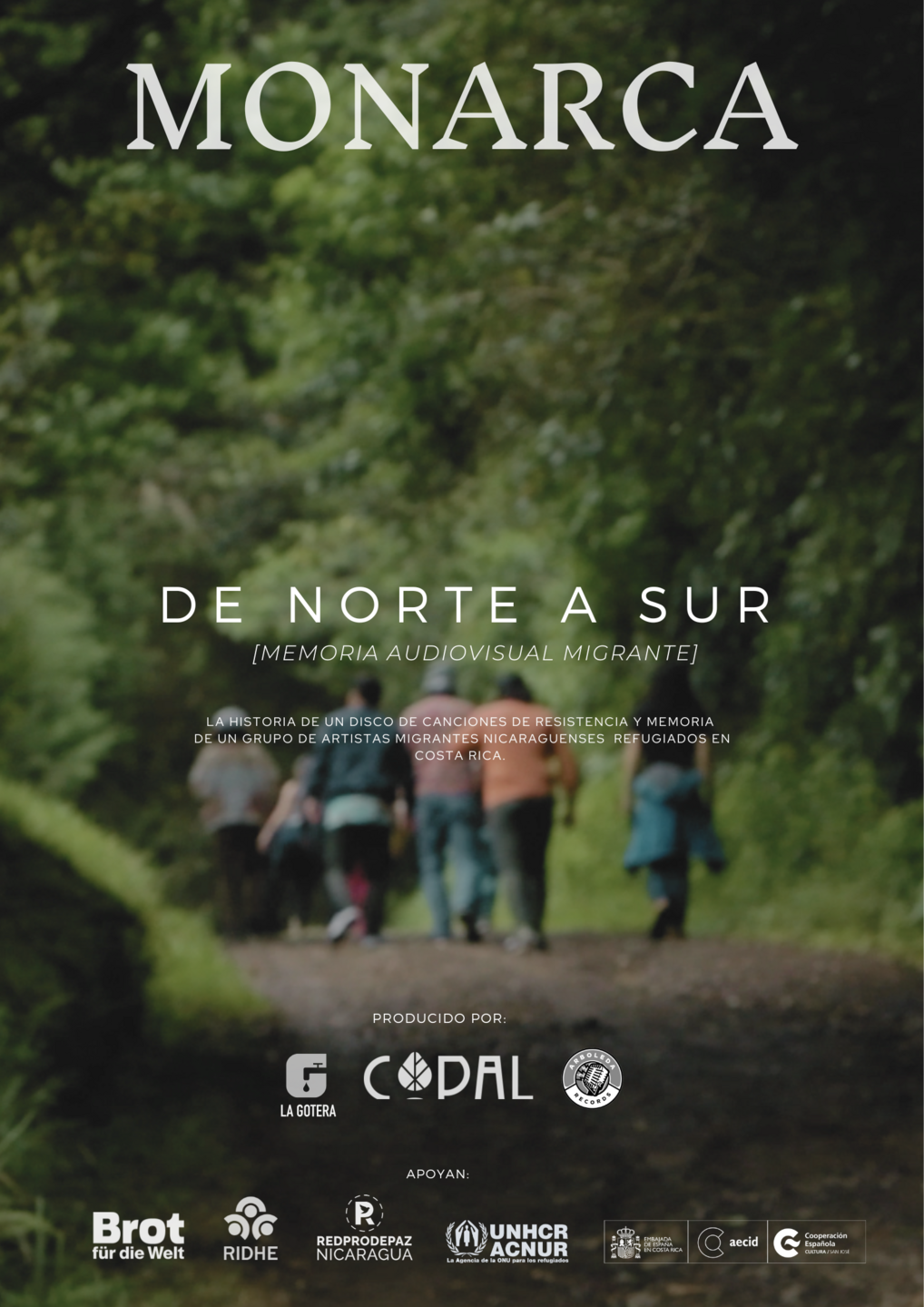
Monarca from North to South: An Audiovisual Memory of Exile
English
This presentation centers on the projection of the 55-minute documentary Monarca de Norte a Sur: An Audiovisual Memory of Exile, an artistic research project that reveals the fragile yet resilient conceptual worlds of Nicaraguan musicians in diaspora. Drawing on a collective of twelve composers based in San José, Costa Rica, the film captures how these artists reconstruct musical landscapes that an authoritarian regime sought to erase — sonic worlds that embody precarious knowledge, expression, and cultural continuity. In doing so, the documentary acts as an artistic intervention into the politics of memory and epistemic survival, documenting endangered conceptual worlds shaped by repression, displacement, and resistance.
The narratives in Monarca de Norte a Sur reflect the concrete experiences of exile resulting from the authoritarian violence unleashed by the Ortega–Murillo regime since 2018, and intensifying against cultural producers post-2022. Produced by COPAL (Colectivo de Artistas y Productores Latinoamericanos), this documentary is itself a form of artistic research: it documents, preserves, and disseminates knowledge that otherwise risks disappearance, and it activates collective memory as a site of critical inquiry and creative response. The project aligns with SAR’s emphasis on artistic research that engages with precarious forms of knowledge — practices that are socially and politically entangled and that generate alternative ways of seeing, hearing, and knowing the world.
As executive producer and historian of memory and authoritarianism, I propose screening the film with English subtitles to open dialogue between artistic practice and research at SAR. The presentation reflects on music as artistic research that preserves endangered conceptual worlds and minoritised knowledges, foregrounding memory-based justice and collective imagination in contexts of repression, exile, and global authoritarian resurgence.
The narratives in Monarca de Norte a Sur reflect the concrete experiences of exile resulting from the authoritarian violence unleashed by the Ortega–Murillo regime since 2018, and intensifying against cultural producers post-2022. Produced by COPAL (Colectivo de Artistas y Productores Latinoamericanos), this documentary is itself a form of artistic research: it documents, preserves, and disseminates knowledge that otherwise risks disappearance, and it activates collective memory as a site of critical inquiry and creative response. The project aligns with SAR’s emphasis on artistic research that engages with precarious forms of knowledge — practices that are socially and politically entangled and that generate alternative ways of seeing, hearing, and knowing the world.
As executive producer and historian of memory and authoritarianism, I propose screening the film with English subtitles to open dialogue between artistic practice and research at SAR. The presentation reflects on music as artistic research that preserves endangered conceptual worlds and minoritised knowledges, foregrounding memory-based justice and collective imagination in contexts of repression, exile, and global authoritarian resurgence.
- Antonio Monte Casablanca is an Associate Professor of History at the National University, Costa Rica. He holds a Dr. phil. in History by the Free University of Berlin (Germany). His main area of research focuses on the relationship between society, culture and authoritarianism, especially during the Somoza dictatorship in Nicaragua (1936-1979). His latest publications are: 1. The co-edited special issue of Istmo: Online Central American Journal of Literature and Cultural Studies, titled: “Texturas Aurales del Istmo”, available at: http://istmo.denison.edu/n49/dossier/index.html; 2. His doctoral tesis, Atractivismo: Historia de la institucionalización y naturalización del turismo en Nicaragua (1936-1979), was published by Herder in 2024.
The documentary has been projected in international conferences on solidarity with Nicaraguan in Cologne and Nuremberg, Germany.
It was also shown in the SOMOS festival of Human Rights sponsored by the NGO, People in Need. In this festival the documentary won the award for best short-documentary or film.
It was also shown in the SOMOS festival of Human Rights sponsored by the NGO, People in Need. In this festival the documentary won the award for best short-documentary or film.
Requirements
I might be able to be together with the director of the documentary. Due to security reasons, I am not able to disclose her name. There is a chance that she might join me on a presentation in Berlin in June, so we might be able to fly together to Galway for this presentation.
The documentary needs a projector, a screen and good audio.
Security is at risk for all Nicaraguans that expose the dictatorship in international forums. I might have to cancel my particular participation in case my family in Nicaragua recieves threats or is subject to any form of surveilance. This has not happened yet, so I don't think it would be a problem. Also, it won't mean a problem to show the documentary.
Níl