Secondary tabs
Submission information
Submission Number: 334
Submission ID: 400
Submission UUID: 4563ea5b-9cc8-4533-bbb8-db52567cb7d3
Submission URI: /ga/form/submit-contribution
Cruthaithe: Sun, 1 Mar 2026 - 19:08
Déanta: Sun, 1 Mar 2026 - 19:32
Changed: Wed, 13 May 2026 - 08:18
Remote IP address: 143.50.33.20
Submitted by: Anonymous
Teanga: English
Is draft: Níl
Current page: webform_confirmation
Flagged: Tá
Personal Information
Your contribution
Doors to the Future: Imagining more humane migration futures
English
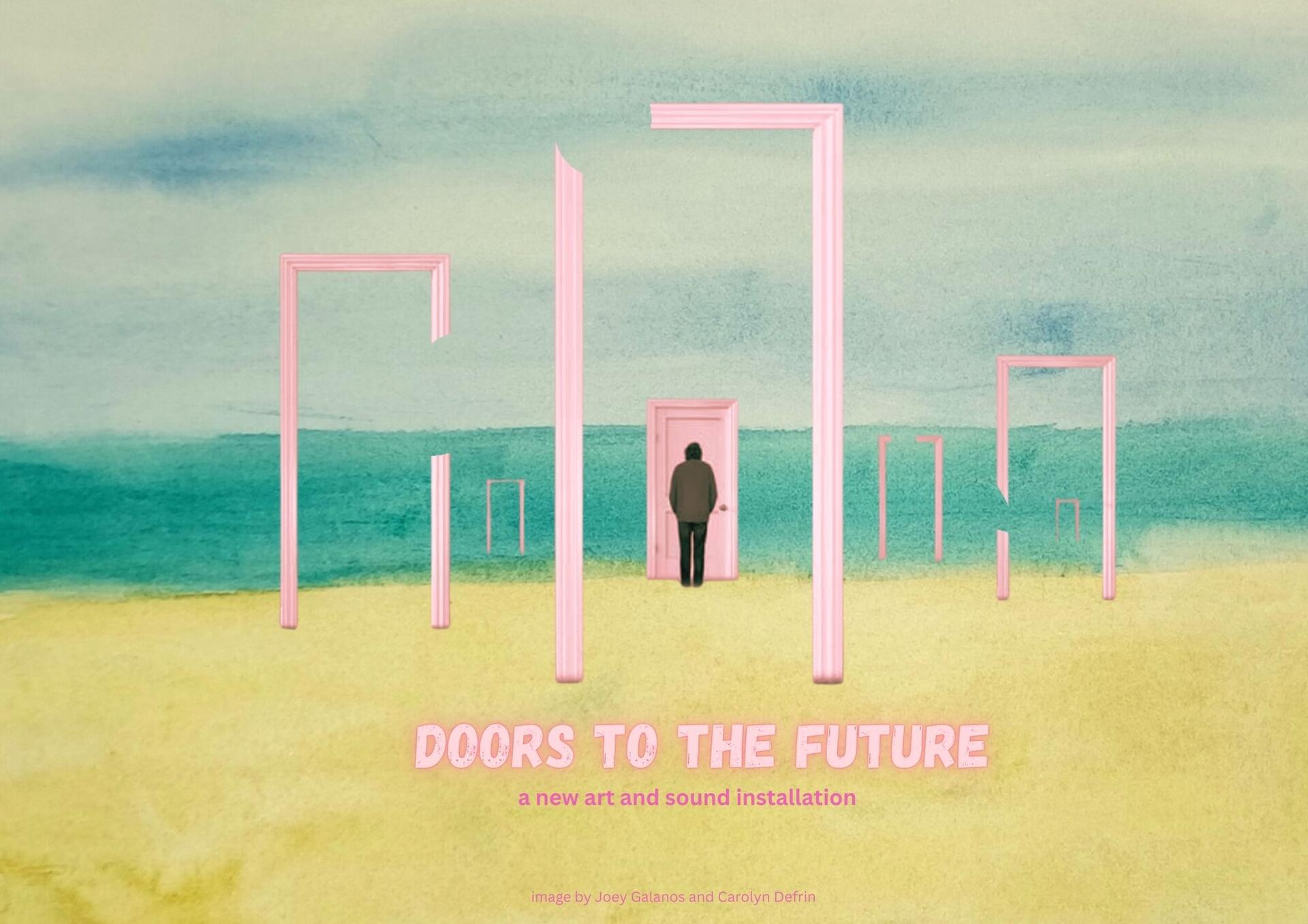
'Doors to the Future' is an immersive sonic installation and participatory workshop engaging migration as an endangered conceptual world: a terrain where dominant policy languages of crisis and security eclipse lived, multilingual, and relational knowledge. Developed in Samos, Greece with asylum seekers, lawyers, educators, artists, and humanitarian workers, the project centres voices diminished by border regimes while foregrounding artistic practice itself as a minoritised epistemology capable of generating alternative timelines.
The installation consists of five QR-coded sonic thresholds. Crossing a doorway activates a multilingual sound world (currently in English, Greek, and Amharic) imagining more humane futures in relation to self, others and the natural world. These imagined future worlds align with St. John’s Eve as a liminal threshold between dark/light and past/future as they were created through a speculative design methodology grounded in intergenerational listening: participants first responded to music from their grandparents’ generation, then crafted sonic futures in dialogue with that inherited wisdom. Genealogy here becomes an ethical relation between memory and responsibility—listening back to create forward.
Presented at SAR, the installation/workshop will invite workshop participants to encounter the doors, engage in facilitated dialogue, and create additional visions for humane migration futures.
Exploring how listening and collaborating within artistic encounters can enable listening and collaborating beyond it, 'Doors to the Future' proposes artistic research as speculative, multilingual, and embodied practice for regenerating endangered conceptual worlds and rehearsing futures policy discourse has yet to articulate.
The installation consists of five QR-coded sonic thresholds. Crossing a doorway activates a multilingual sound world (currently in English, Greek, and Amharic) imagining more humane futures in relation to self, others and the natural world. These imagined future worlds align with St. John’s Eve as a liminal threshold between dark/light and past/future as they were created through a speculative design methodology grounded in intergenerational listening: participants first responded to music from their grandparents’ generation, then crafted sonic futures in dialogue with that inherited wisdom. Genealogy here becomes an ethical relation between memory and responsibility—listening back to create forward.
Presented at SAR, the installation/workshop will invite workshop participants to encounter the doors, engage in facilitated dialogue, and create additional visions for humane migration futures.
Exploring how listening and collaborating within artistic encounters can enable listening and collaborating beyond it, 'Doors to the Future' proposes artistic research as speculative, multilingual, and embodied practice for regenerating endangered conceptual worlds and rehearsing futures policy discourse has yet to articulate.
- Carolyn Defrin is an artist-researcher-facilitator, originally from the US and based at the University of Graz in Austria. In collaboration with local communities and other artists, she works across installation, video, theatre, sound and poetry to express issues related to migration, borders, social cohesion, health and housing. She is currently completing a Marie Skladowska-Curie post-doctoral fellowship exploring the role of art in imagining migration futures beyond current narratives of securitization and division in Samos, Greece and Tenerife, Spain. She is also co-founder of 'Kissing Project', a multimedia platform that brings people together through stories that begin with a kiss. Learn more: carolyndefrin.com
'Doors to the Future' was first developed in Samos, Greece in February 2026. This was its first iteration and it will evolve as it tours to other contexts (both academic settings and arts festivals in the coming year.) Read more here: https://www.carolyndefrin.com/doorstothefuture
Requirements
The installation will adapt from its first context where it was made on the island of Samos in Greece. This can be discussed in more detail with the conference conveners; however, in its simplest form, the installation can exist with designed QR codes placed in appropriate doorways at the conference. Workshop participants will directly experience these by scanning the codes and listening to each of the audio pieces through their own phones/headphones. These QR codes also make the installation accessible to all conference participants throughout the four days.
In terms of the time length of the workshop-- 180 minutes is ideal to enable time to experience the installation, engage in dialogue, learn more about how the project was made, and create additional artworks for migration futures. A 90 minute session can also be considered.
In terms of the time length of the workshop-- 180 minutes is ideal to enable time to experience the installation, engage in dialogue, learn more about how the project was made, and create additional artworks for migration futures. A 90 minute session can also be considered.
For the workshop, it would be best to have a room where we can create a circle of chairs, as well as some tables for creating artworks. In addition, a projector for sharing documentation of the project from its first iteration in Greece.
None.
Tá
Carolyn Defrin