Secondary tabs
Submission information
Submission Number: 317
Submission ID: 382
Submission UUID: 34ead5d8-eb36-4881-bcff-ad4e27fc5442
Submission URI: /ga/form/submit-contribution
Cruthaithe: Sun, 1 Mar 2026 - 15:04
Déanta: Sun, 1 Mar 2026 - 15:17
Changed: Wed, 13 May 2026 - 08:43
Remote IP address: 193.207.222.34
Submitted by: Anonymous
Teanga: English
Is draft: Níl
Current page: webform_confirmation
Flagged: Tá
| Given name | Leonardo |
|---|---|
| Surname | Mezzalira |
| leonardomezzalira@yahoo.it | |
| I understand that by submitting this form, I consent to the use of my data for the purposes of the 2026 Forum on Artistic Research'. | Tá |
| I agree to the terms of service. | Tá |
| Title | Exploring ecological thought in composition: endangerment as a key point on the map |
| Format | Project presentation |
| Main language | English |
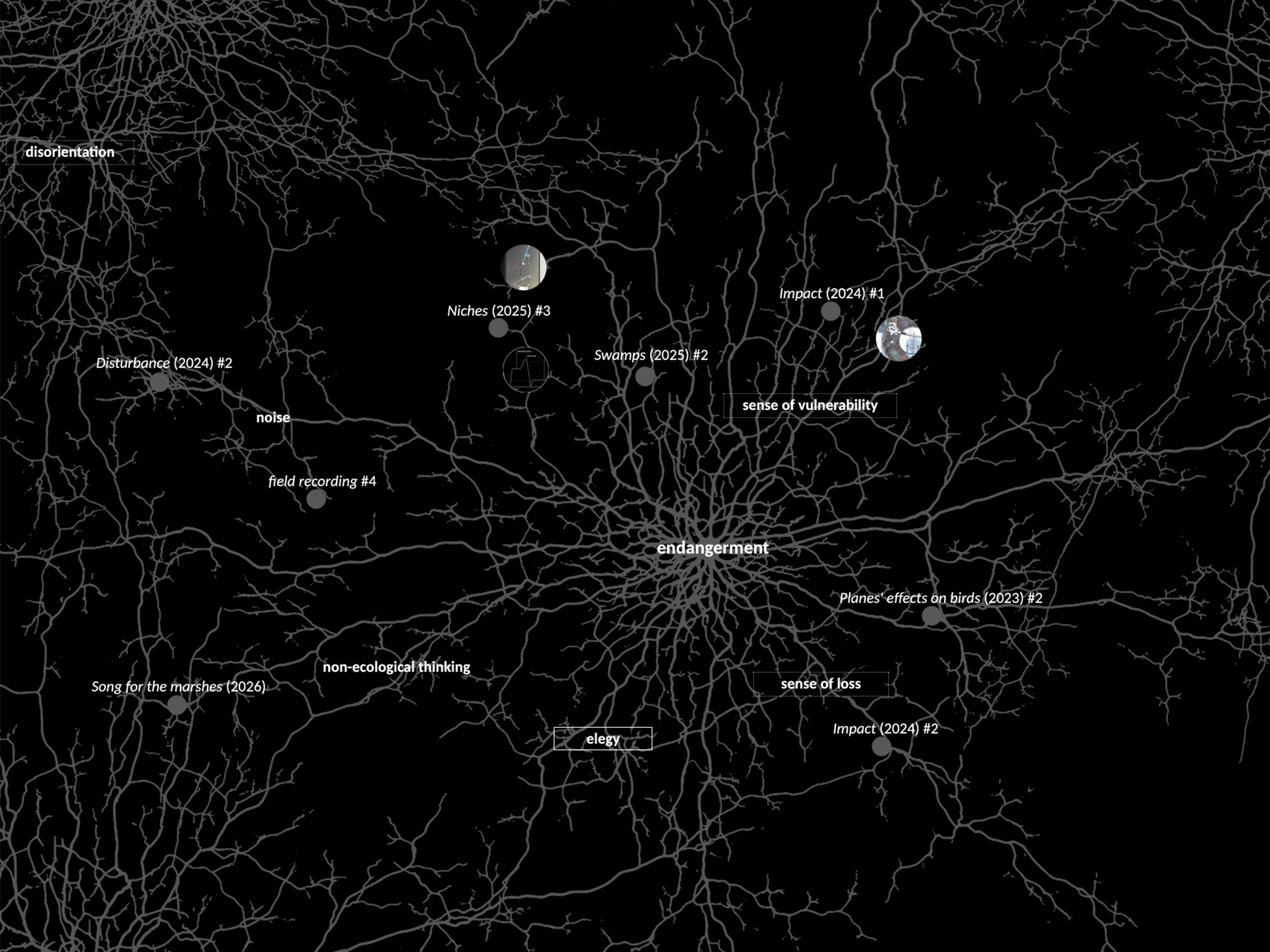
| Abstract | There is no single definition of ecological thought. First emerged in the wake of evolutionary biology, it has since been shaped by multiple influences, among which the rise of systems theory and cybernetics in the mid-twentieth century. In the next decades it has taken on political and philosophical implications, shaping desires and utopias and merging with older and endangered traditions of thought. As it grew into a worldview characterized by layered meanings and a complex set of affective patterns, this form of thought has begun to increasingly inform artistic practices, which in turn have become an essential place to investigate what an ecological approach can be. As a composer engaged with ecological thought, I constantly experience how this approach resists attempts to embrace it comprehensively. Every experiment generates new questions and insights, which in turn are reflected in the next compositional choices. In order to articulate the knowledge that emerges through this exploration, I started drawing a map in which sound excerpts, quotations, preparatory materials and insights coming from other fields are grouped around nodes of intensity, with a close intertwining between verbal and non-verbal elements—and between the cognitive and the affective. After an overview of some of the many possible itineraries within this map, my presentation focuses on “endangerment” as one of the main cognitive-affective intensity nodes within ecological thought, and shows its connections and tensions with other nodes, among which “situatedness” and “organicity”. The constellation of practices and materials around these nodes can be intended as an ongoing assemblage capable of bringing out connections between different fields and of hinting at the existence of still unexplored areas. In this sense, the map is also a generative tool, because it allows to identify patterns and tensions in practice and theory and to find new gaps to address in future research. |
| Link to the Exposition | https://www.researchcatalogue.net/shared/03fde61a16cfc7de3da5a471ec2d5286 |
| Image |
|
| Short biographies of the presenter(s) |
|
| Previous presentations or iterations of the research | |
| Additional information | |
| Spatial and technical requirements | No special requirements, except a normal projection and audio system. |
| Potential risks or ethical concerns | |
| Create a user account for SAR 2026 | Níl |