Secondary tabs
Submission information
Submission Number: 307
Submission ID: 372
Submission UUID: 6e33ce18-847c-4bc7-aa91-ea1a227c96e1
Submission URI: /ga/form/submit-contribution
Cruthaithe: Sun, 1 Mar 2026 - 11:56
Déanta: Sun, 1 Mar 2026 - 11:57
Changed: Wed, 13 May 2026 - 08:14
Remote IP address: 84.115.238.112
Submitted by: Yilmaz Vurucu
Teanga: English
Is draft: Níl
Current page: webform_confirmation
Personal Information
Your contribution
Paths Under Pressure: Nomadic Knowledge and Alternative Lifestyles in the Capitalocene
English
This artistic research project investigates the endangered material culture, ecological knowledge, and social structures of Anatolia’s Yörük nomads, whose traditional lifeways are under threat from forced settlement policies, climate instability, and capitalist extraction. Through participant observation, filmmaking, and collaborative ethnography, we explore how Yörük tent-making, goat-hair weaving, herding, and seasonal migration (Göç) embody a metabolic balance misaligned with the extractive logic of the Capitalocene. Rather than treating Yörük practices as folklore, we engage with them as valid epistemic systems, centering co-creation, shared decision-making, and relational trust to resist extractive research paradigms.
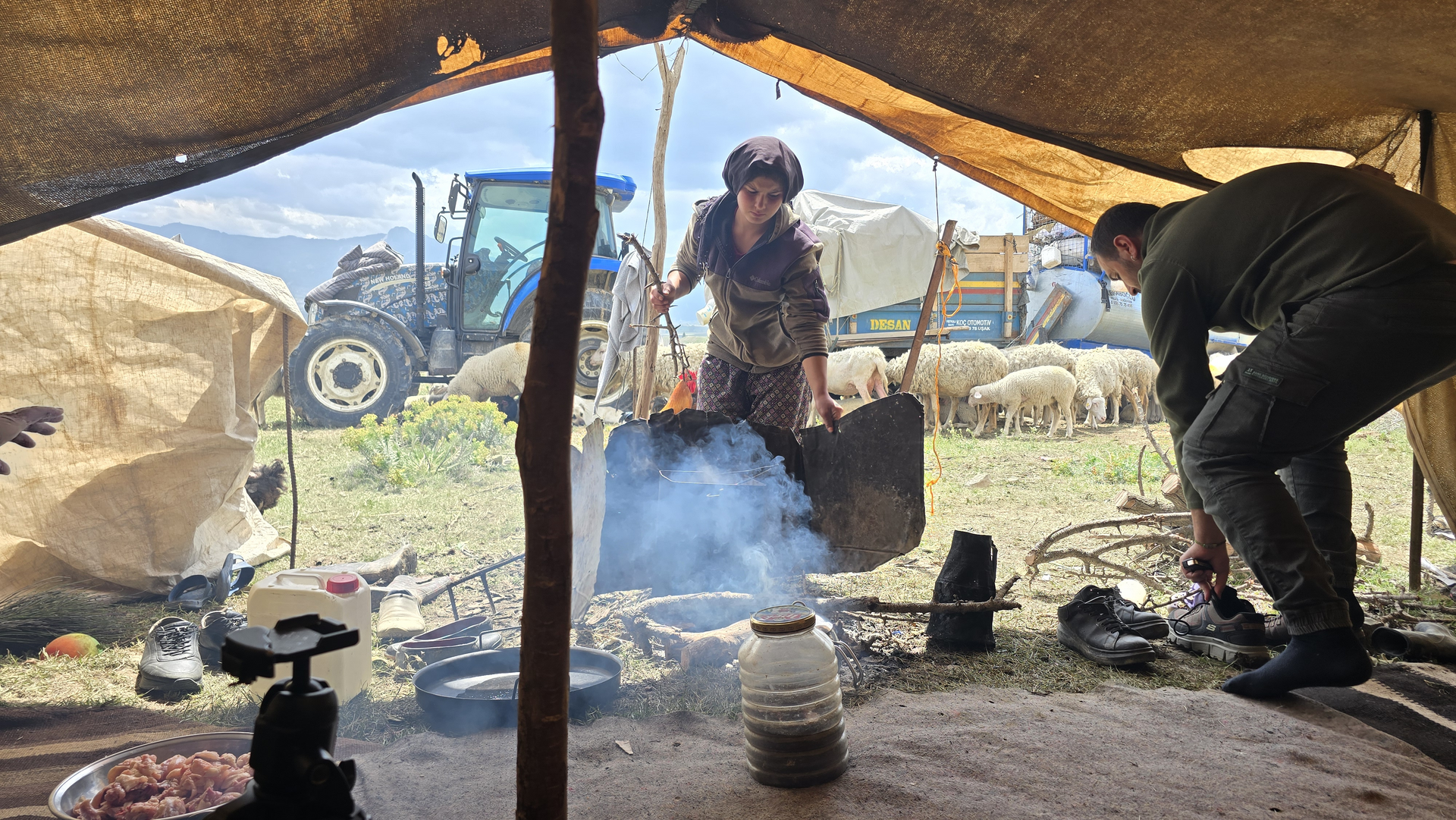
Initial fieldwork with tribes in Ahmetli, Kuyucak, Başaran, Yatağan, and the Taurus Mountains reveals a spectrum of adaptation and precarity: from the fragmentation of migration routes by privatization and industrial expansion to the resilience of pragmatic adaptations, such as solar-powered tents and digital connectivity.
The Yörük’s decentralized, undogmatic knowledge systems, rooted in cyclical mobility, communal labor, and reciprocal relations with the land, offer counter-models to the homogenizing forces of modernity. Their tents, weaving techniques, and seasonal rhythms reflect an ecological intelligence now strained by ecological degradation and economic pressures.
Initial findings, including video documentation of Göç traditions and tent-making, highlight the tensions between memory and practice, as elders’ testimonies and adaptive strategies (e.g., solar panels, boot-making revival) reveal both loss and resistance. Future research will deepen these engagements, joining the 2027 Göç to document how Yörük communities navigate a shrinking world, where ancestral pathways and meanings are increasingly fragile. The project aims to co-create a multimodal archive that preserves their knowledge.
Initial fieldwork with tribes in Ahmetli, Kuyucak, Başaran, Yatağan, and the Taurus Mountains reveals a spectrum of adaptation and precarity: from the fragmentation of migration routes by privatization and industrial expansion to the resilience of pragmatic adaptations, such as solar-powered tents and digital connectivity.
The Yörük’s decentralized, undogmatic knowledge systems, rooted in cyclical mobility, communal labor, and reciprocal relations with the land, offer counter-models to the homogenizing forces of modernity. Their tents, weaving techniques, and seasonal rhythms reflect an ecological intelligence now strained by ecological degradation and economic pressures.
Initial findings, including video documentation of Göç traditions and tent-making, highlight the tensions between memory and practice, as elders’ testimonies and adaptive strategies (e.g., solar panels, boot-making revival) reveal both loss and resistance. Future research will deepen these engagements, joining the 2027 Göç to document how Yörük communities navigate a shrinking world, where ancestral pathways and meanings are increasingly fragile. The project aims to co-create a multimodal archive that preserves their knowledge.
- Yilmaz Vurucu is a researcher and filmmaker whose work examines how material conditions(resources, technology, and social relations) that reproduce power, ideology, and resistance. His research, including a thesis on cults and capitalism and an ongoing PhD on techno-capitalism, interrogates the mechanisms of coercion, extraction, and systemic inequality, while his study of Yörük nomadic traditions offers alternative models of metabolic living in the Capitalocene. Through x-arts, he employs artistic-based research to use art and storytelling as a tool for social activation. With Wonderland, he co-designs social programming, Urban Living Labs, and participatory projects to foster exchange and amplify community-led solutions.
{Empty}
Requirements
Nomadism in the Anthropocene is a work-in-progress. It’s an artistic research project that aims to document and analyze the endangered material knowledge systems of the Yörük nomads of Türkiye – particularly from two main vantage points: uncovering undocumented knowledge and situating their struggle to exist and pass on their knowledge in relation to the pressures by all-encompassing capitalist–settler infrastructures and the ecological crises of the Anthropocene. For the presentation, I would like to present our findings, share photos and video recordings, and present how we intend to work on and further develop this research by attending the Migration in 2027 with various tribes. I would also specifically like to present various material production techniques the Yörük use, their relations with the society around them, among each other, and with nature itself.
A screen, beamer and speakers.
There are no potential risks or concerns at the moment, the tribes we work with are fully emerged in our research and are aware of how they will contribute towards it.
Níl