Secondary tabs
Submission information
Submission Number: 277
Submission ID: 339
Submission UUID: d1f3546e-b690-409e-9d28-dc823f16dc50
Submission URI: /ga/form/submit-contribution
Cruthaithe: Sat, 28 Feb 2026 - 23:52
Déanta: Sun, 1 Mar 2026 - 00:19
Changed: Wed, 13 May 2026 - 08:14
Remote IP address: 43.227.109.196
Submitted by: Anonymous
Teanga: English
Is draft: Níl
Current page: webform_confirmation
| Given name | Rachel |
|---|---|
| Surname | Meyers |
| rachelmeyers81@gmail.com | |
| I understand that by submitting this form, I consent to the use of my data for the purposes of the 2026 Forum on Artistic Research'. | Tá |
| I agree to the terms of service. | Tá |
| Title | Composing below articulation: embodied knowledge and the risk of making it sayable |
| Format | Project presentation |
| Main language | English |
| Abstract | What happens when you try to name knowledge that operates before naming? This project investigates that question through three years of cold-water swimming at Kingston Beach, Southern Tasmania (2022–2025), and its effects on compositional practice. Systematic shifts emerged over that period — in harmonic density, formal boundary articulation, temporal organisation — that preceded conscious recognition and presented as intuitive necessities. This project proposes retrospective portfolio analysis as a method for tracing those pre-reflective transformations without claiming transparent access to them. What analysis revealed exceeded what longitudinal portfolio comparison alone could account for. Attempts to attribute compositional innovations to any single domain — swimming, theoretical engagement, ethical commitment, expanding craft — consistently failed. The evidence pointed toward multiple domains operating convergently within compositional intuition before any could be separately identified. Electroacoustic work Thalassic tests whether the dynamics that emerged can be operationalised as explicit methodology without displacing the embodied judgement from which they arose. What the process suggested is scalar: explicit frameworks can govern macro-structural design while embodied responsiveness continues operating at the micro-compositional level. Articulation may not need to absorb what it names. In research cultures driven by optimisation and measurable output, long-duration embodied immersion risks minoritisation as method. This project argues such practices are not residues of pre-theoretical art making but epistemic resources — and that criteria exist for examining them without flattening them into a system. |
| Link to the Exposition | https://www.researchcatalogue.net/shared/df581ae94ec61c237e91b658baca4b4d |
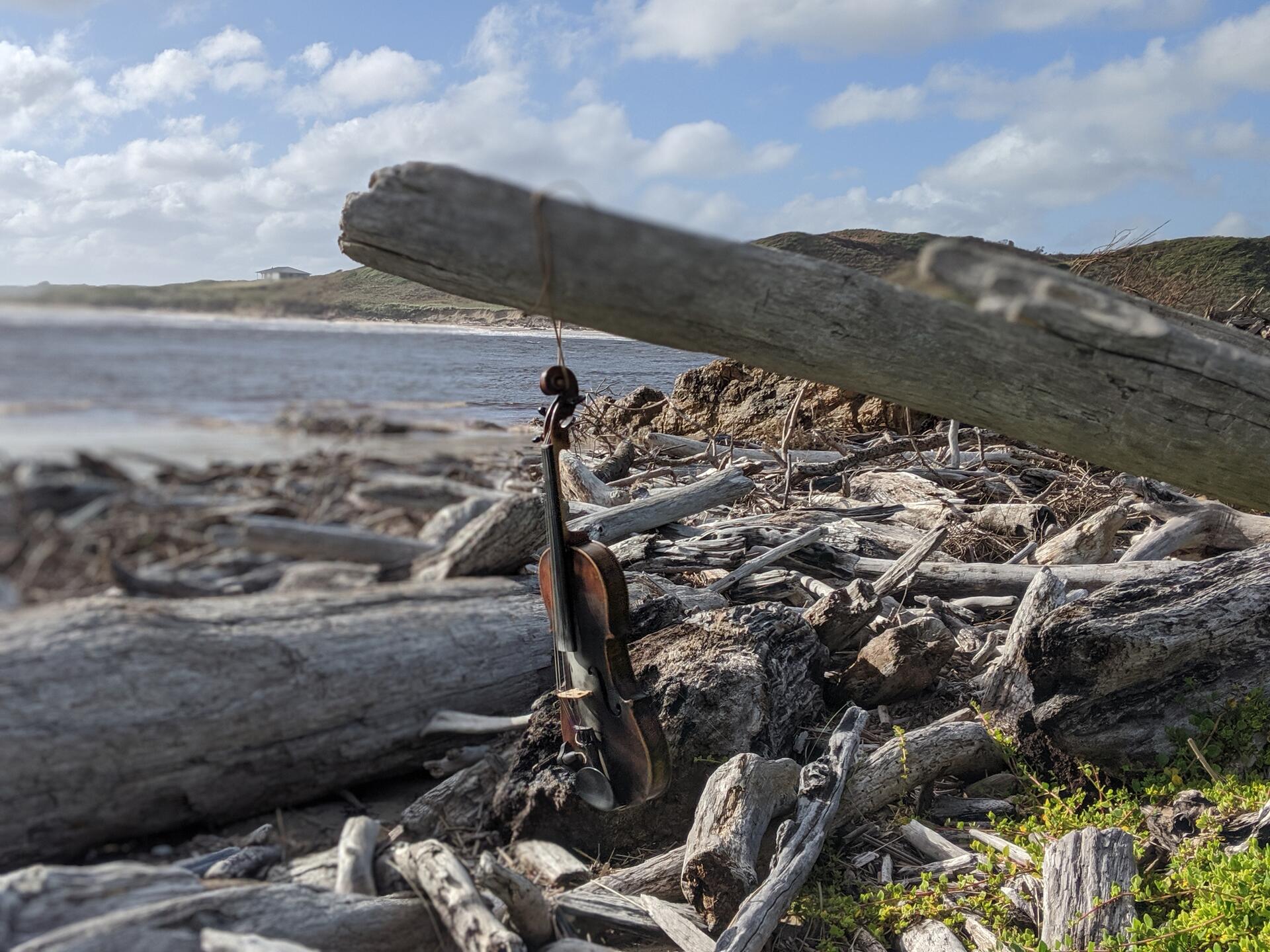
| Image |
|
| Short biographies of the presenter(s) |
|
| Previous presentations or iterations of the research | N/A |
| Additional information | Thalassic can be presented in stereo, which requires no specialist equipment beyond a standard audio playback setup. Multichannel presentation is also possible and would enact the research's methodology more fully: speakers distributed through the space, each carrying a distinct channel, allow audience members to move freely and compose their own mix — a controlled indoor analogue of the distributed sound walk proposed in the exposition. A site-specific sound walk remains a further possibility if the program allows. The presenter is happy to work within whatever format the venue supports. |
| Spatial and technical requirements | Minimum: Stereo speakers and standard audio playback (laptop/interface). Preferred: 4–8 speakers distributed through the presentation space, each on a separate channel, with a multichannel audio interface. Speakers should be freestanding or floor-mounted to allow audience movement between them. If site-specific work is possible: Outdoor space accessible during the program, with participants carrying portable speakers. |
| Potential risks or ethical concerns | N/A |
| Create a user account for SAR 2026 | Tá |
| Create new user |