Secondary tabs
Submission information
Submission Number: 264
Submission ID: 326
Submission UUID: 181a16d3-b29a-4445-8e08-6c925a20ba29
Submission URI: /ga/form/submit-contribution
Cruthaithe: Sat, 28 Feb 2026 - 21:05
Déanta: Sat, 28 Feb 2026 - 22:52
Changed: Wed, 13 May 2026 - 08:23
Remote IP address: 87.212.40.178
Submitted by: Anonymous
Teanga: English
Is draft: Níl
Current page: webform_confirmation
Flagged: Tá
| Given name | Feilim |
|---|---|
| Surname | O'hAolain |
| f.ohaolain@artez.nl | |
| I understand that by submitting this form, I consent to the use of my data for the purposes of the 2026 Forum on Artistic Research'. | Tá |
| I agree to the terms of service. | Tá |
| Title | The Semiotics of Synthetic Spaces: Embodied Knowledge and Multilingual Narratives in Digital Performance |
| Format | Experimental format |
| Main language | English |
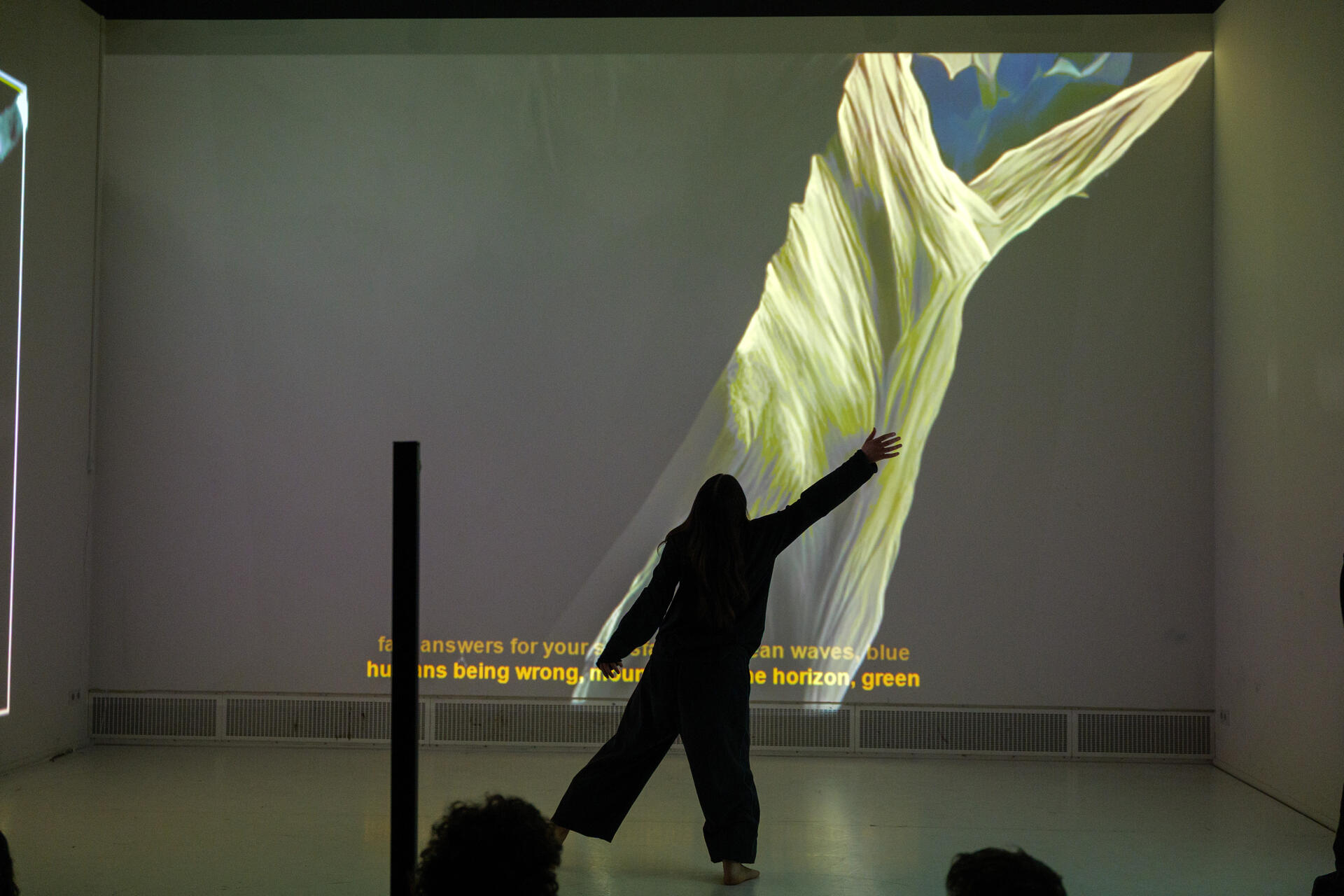
| Abstract | This proposal, developed by the Future Storytelling Lab (FSL), investigates the creative and pedagogical potential of generating visual naratives in performance and artistic research. Led by Feilim Ó hAoláin (Programme Coordinator, FSL), the session brings together Niek Van Oosterweyk (dancer/choreographer), Cris Molee (technologist), and Pol Eggermont (dramaturg & technologist) to explore how AI-driven image generation can enhance interdisciplinary collaboration between movement, language, and digital media. In this laboratory setting, participants will experiment live with generative design softwares, converting embodied movement and multilingual prompts into AI-generated visual narratives. Through practice-based experimentation, the workshop not only explores how AI can reshape artistic practices, but also fosters critical reflection on these performances or happenings—examining their aesthetic, ethical, and conceptual implications. Participants will: -Experiment with Stable Diffusion as a performative and educational medium, integrating movement, voice, and multilingual input. -Discuss strategies for embedding AI in arts education, focusing on interdisciplinary learning, digital literacy, and collaborative creation. -Explore how AI challenges boundaries between physical/digital performance and the roles of creator, performer, and audience. -Address key tensions, such as authorship, agency, and the algorithm’s role in live and educational settings. Drawing on the Future Storytelling Lab’s expertise in experimental pedagogy and performance technology at ArtEZ University, the workshop will equip participants with actionable insights for integrating AI into their research or alternatively creating a space of critique and dialogue around this emerging technology. Designed for artists, educators, and researchers, this session invites reimagining AI as a tool for innovation, storytelling, and critical inquiry in contemporary practice. |
| Image |
|
| Short biographies of the presenter(s) |
|
| Previous presentations or iterations of the research | An earlier inspiration of this proposed laboratory took place at ArtEZ University's Future Labs programme in January 2026. During a project week with a inter disciplinary group of bachelor theater and dance students, participants were invited to explore and experiment in a workshop based around stable diffusion led by technologist Cris Mollee. It was the first of its kind at ArtEZ University and feedback from students and teachers respectively led to further considerations to develop it. |
| Additional information | This experiment holds particular significance in bridging the artistic research landscapes of the Netherlands and Ireland, two countries with rich traditions in interdisciplinary performance, multilingual storytelling, and digital innovation. Both nations share a strong emphasis on experimental pedagogy and the integration of emerging technologies into creative practices, making this workshop a timely exploration of shared methodologies and cultural exchange. The Netherlands and Ireland have become hubs for artistic research that merges technology with embodied practices. The experiment/lab serves as a case study for how AI can act as a catalyst or even a threat to new forms of artistic dialogue, particularly in educational and community-driven settings. By examining the similarities in how both countries approach AI, movement, and language, the workshop not only advances technical and creative methodologies but also strengthens transnational connections in artistic research. |
| Spatial and technical requirements | A large black box/white cube studio is the most ideal setting for this event but it it could be suitable within certain perameters in other locations. basic requirements: Large projection back walls (white) Ideally or prospectively x3 walls whereby projection would be 270 degree from a ceiling. Showcasing both the outcome or visualisation but also the components of creating stable diffusion and touch designer elements. |
| Potential risks or ethical concerns | The workshop explicitly engages with ethical questions surrounding AI in artistic practice such as Authorship & Agency (Who "owns" AI-generated work, and how do we credit human/machine collaboration?), Bias & Representation (How do training datasets and algorithms influence (or limit) creative output, particularly in multilingual and multicultural contexts?),Embodiment & Consent (What are the implications of using biometric data (movement, voice) in live AI performances). |
| Create a user account for SAR 2026 | Níl |