Secondary tabs
Submission information
Submission Number: 262
Submission ID: 323
Submission UUID: 2ddf87ef-80fe-4cc2-8151-da0a597af34d
Submission URI: /ga/form/submit-contribution
Cruthaithe: Sat, 28 Feb 2026 - 19:10
Déanta: Sat, 28 Feb 2026 - 22:29
Changed: Wed, 13 May 2026 - 08:12
Remote IP address: 87.221.49.170
Submitted by: Anonymous
Teanga: English
Is draft: Níl
Current page: webform_confirmation
Personal Information
Your contribution
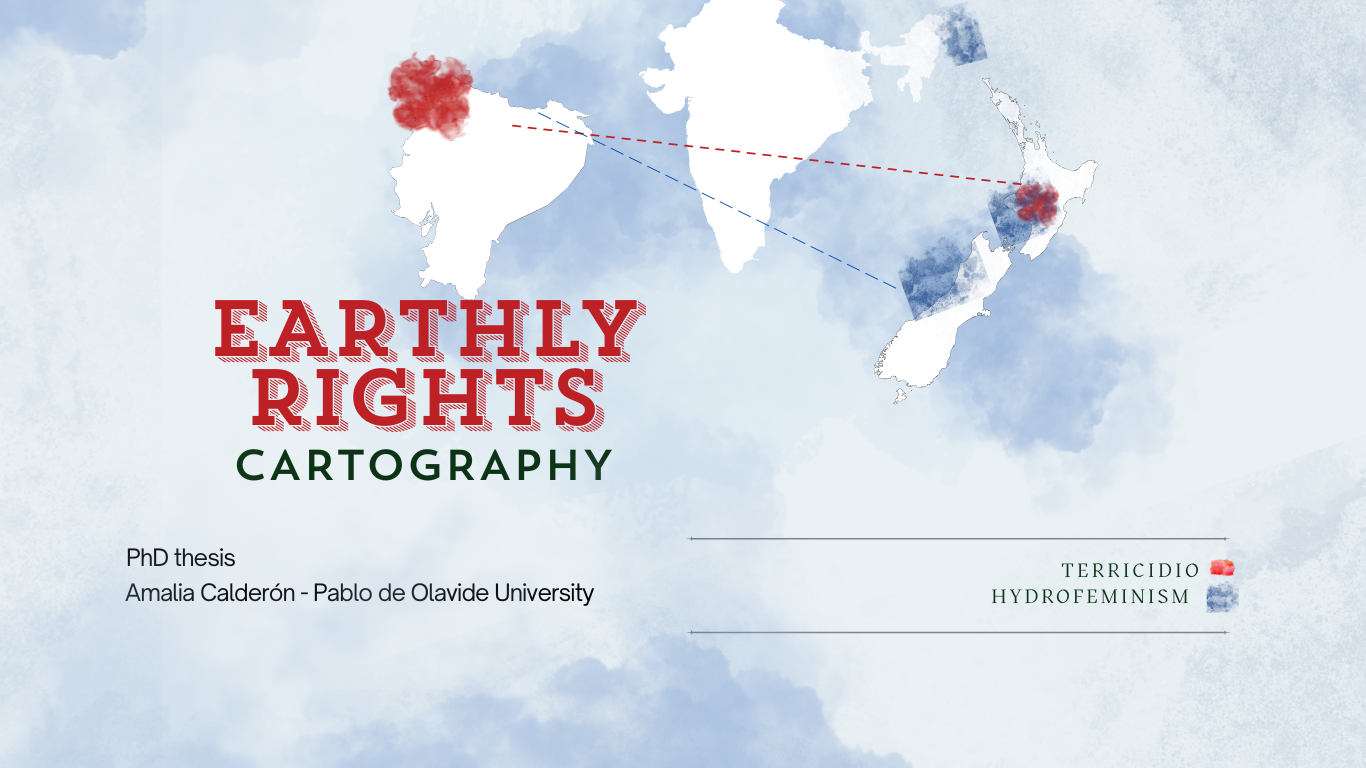
Earthly Rights Cartography
English
The Earthly Rights Cartography is a doctoral thesis mapping the body of ecological law in different local and supranational jurisdictions through the use of an experimental cartographic method. It challenges the anthropocentric perception of nature bodies, interpreting the language of emerging legal texts in Earthly jurisprudence, so as to reveal specific meanings about their agency. In times of polycrisis, analyzing socio-ecological conflicts from this perspective allows us to address the urgent challenges of international legal practice. By creating an annotated visual tool that encompasses the developments in our legal language, this project will examine which practices work and which legal conceptual worlds can be pursued, as well as address potential obstacles to these new strategies. Thus offering a crucial opportunity to explore new conceptual horizons of coexistence and planetary and environmental justice.
The project will compile a linguistic corpus of jurisprudence on the Rights of Nature. Through a comparative case study within the framework of the Global North and South, key words and texts will be identified and transposed into a textual map. This map will be structured in visual layers corresponding to different categories—i.e. terricide, hydrofeminism, unequal socio-ecological exchange and intergenerational justice—represented as routes connecting specific cases; articulating how different extrapolations of legal agency toward the bodies of nature can overlap, contradict, or complement others. The research will employ an interdisciplinary methodology of legal linguistics analysis and artistic research. Its theoretical foundation will adopt a materialist, feminist, and decolonial epistemological framework, engaging with and contributing to the work of key figures in posthumanist law: Dianne Otto, Emily Jones. The mapping methodology will be based on the speculative models of Anna Tsing's Feral Atlas and Lawrence Abu Hamdan's Earwitness Inventory.
The project will compile a linguistic corpus of jurisprudence on the Rights of Nature. Through a comparative case study within the framework of the Global North and South, key words and texts will be identified and transposed into a textual map. This map will be structured in visual layers corresponding to different categories—i.e. terricide, hydrofeminism, unequal socio-ecological exchange and intergenerational justice—represented as routes connecting specific cases; articulating how different extrapolations of legal agency toward the bodies of nature can overlap, contradict, or complement others. The research will employ an interdisciplinary methodology of legal linguistics analysis and artistic research. Its theoretical foundation will adopt a materialist, feminist, and decolonial epistemological framework, engaging with and contributing to the work of key figures in posthumanist law: Dianne Otto, Emily Jones. The mapping methodology will be based on the speculative models of Anna Tsing's Feral Atlas and Lawrence Abu Hamdan's Earwitness Inventory.
- Amalia Calderón is a PhD researcher at the University of Pablo de Olavide, with a thesis in political ecology and philosophy of law. She holds a Law & Sociology bachelors degree from Warwick University, and a Sociology of Gender & Sexuality masters and Artistic Research research masters from the University of Amsterdam. Calderón's practice explores Earth jurisprudence, posthumanist law and feminist pedagogies. Calderón has been a guest lecturer at the Gerrit Rietveld Academie, and has co-designed and co-coordinated an interdisciplinary course at the UvA. Her publications appear in Kunstlicht, ArtEZ, the Rijksakademie, among others. Calderón was part of the editorial board of Soapbox Journal of Cultural Analysis, and a peer reviewer for JAR.
{Empty}
Requirements
{Empty}
{Empty}
{Empty}
Tá
Amalia Calderón