Secondary tabs
Submission information
Submission Number: 235
Submission ID: 294
Submission UUID: 520a968d-104d-4aaf-8516-a7459df93801
Submission URI: /ga/form/submit-contribution
Cruthaithe: Sat, 28 Feb 2026 - 14:35
Déanta: Sat, 28 Feb 2026 - 15:00
Changed: Wed, 13 May 2026 - 08:53
Remote IP address: 178.51.120.224
Submitted by: Pietro Pancella
Teanga: English
Is draft: Níl
Current page: webform_confirmation
Flagged: Tá
Personal Information
Your contribution
A Vuoto: Gesture, Non-Dualism and Inoperativity in Musical Improvisation
English
In this presentation I introduce my PhD project A Vuoto, which reconsiders musical improvisation through the lens of non-dual philosophies developed outside the Western canon. As a double bass player and improviser, I explore presence and gesture beyond functional logics, questioning interpretations of embodiment that emphasise the body as the site of artistic production.
First, I outline how non-dual philosophies such as Advaita Vedānta and Taoism make it possible to question distinctions between subject and object, performer and instrument, approaching music as an ontological experience rather than an act centred on an individual agent. In this framework, non-dual thought offers a counterpoint to dominant Western approaches to corporeality and experience, opening space for ways of knowing that tend to remain overlooked.
I then explore the concept of inoperativity, as conceived by Giorgio Agamben, as a practical and epistemic principle grounded in the suspension of productive function. Through the practice of “suonare a vuoto” — literally “playing into the void”, an Italian expression denoting an action deliberately without a direct result — the body is withdrawn from the role of producing sound and allowed to appear in its potentiality and availability to what happens.
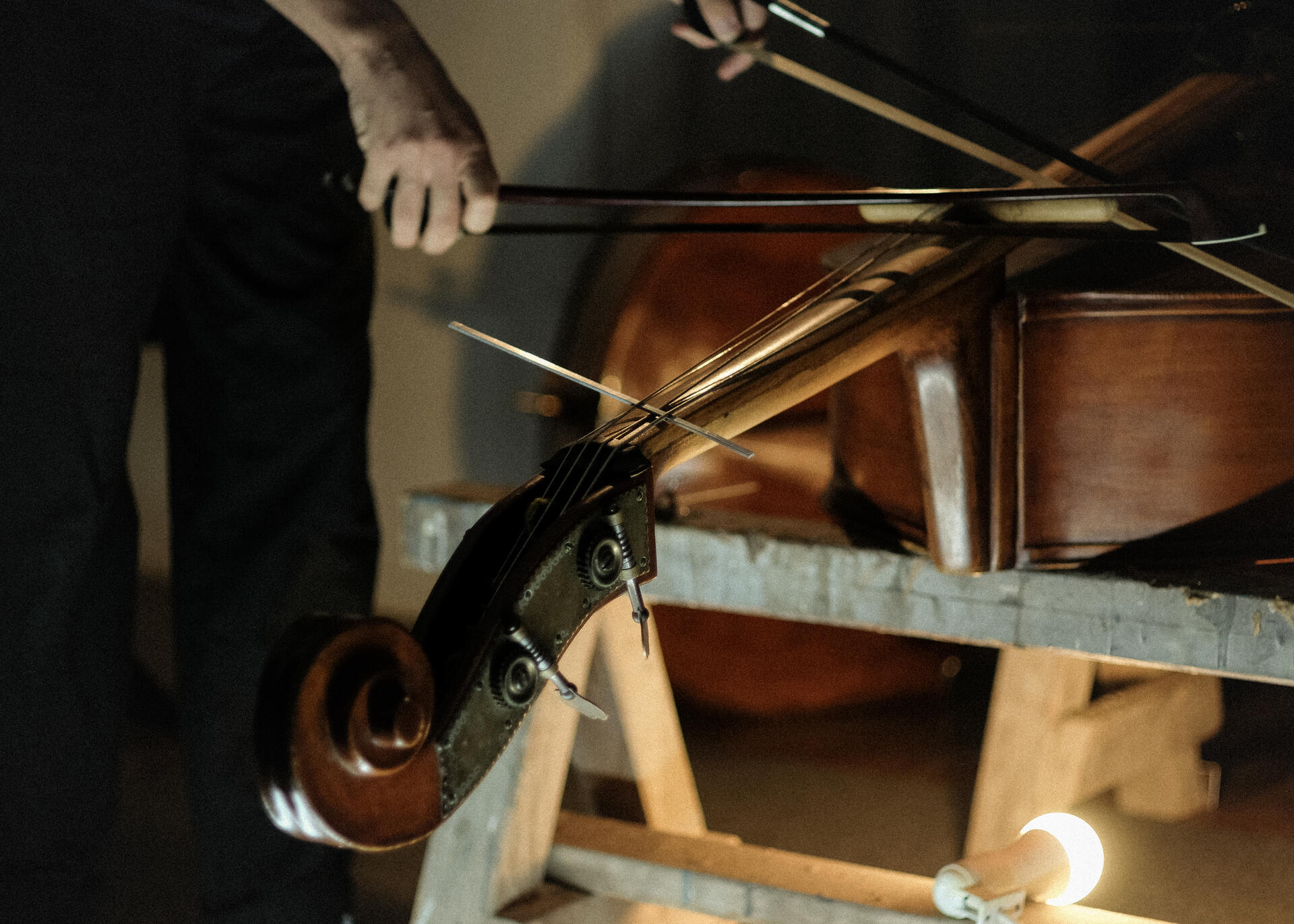
Finally, I focus on gesture as the site where theory and practice converge. I analyse liminal zones emerging in two performative contexts: Muta, for three double basses and two performers, where awkward configurations foreground bodies beyond instrumental efficiency; and a practice of conducted improvisation, in which gesture does not directly govern sound but suspends will, activating unpredictable relations between bodies, instruments, and listening.
In this way, gesture and inoperativity do not simply negate production, but shift attention toward forms of improvisation that resist complete reduction to functionality, opening space for fragile, often ineffable modes of experience.
First, I outline how non-dual philosophies such as Advaita Vedānta and Taoism make it possible to question distinctions between subject and object, performer and instrument, approaching music as an ontological experience rather than an act centred on an individual agent. In this framework, non-dual thought offers a counterpoint to dominant Western approaches to corporeality and experience, opening space for ways of knowing that tend to remain overlooked.
I then explore the concept of inoperativity, as conceived by Giorgio Agamben, as a practical and epistemic principle grounded in the suspension of productive function. Through the practice of “suonare a vuoto” — literally “playing into the void”, an Italian expression denoting an action deliberately without a direct result — the body is withdrawn from the role of producing sound and allowed to appear in its potentiality and availability to what happens.
Finally, I focus on gesture as the site where theory and practice converge. I analyse liminal zones emerging in two performative contexts: Muta, for three double basses and two performers, where awkward configurations foreground bodies beyond instrumental efficiency; and a practice of conducted improvisation, in which gesture does not directly govern sound but suspends will, activating unpredictable relations between bodies, instruments, and listening.
In this way, gesture and inoperativity do not simply negate production, but shift attention toward forms of improvisation that resist complete reduction to functionality, opening space for fragile, often ineffable modes of experience.
- Pietro Pancella (Italy, 1996) studied double bass, electric bass, and jazz composition. He also earned a diploma in Oriental and Intercultural Philosophy. In 2024 began a PhD in Composition and Musical Performance at the Conservatoire "L. D'Annunzio" of Pescara, now is currently a visiting researcher at the Royal Conservatoire of Antwerp. Awarded numerous prizes, he appears on several albums and collaborates with internationally renowned artists, performing at festivals in Italy and Mexico, Norway, Denmark, Turkey, Belgium, France, Slovakia, and Poland.
LabRAM (Orpheus Institute / Conservatorio di Pescara, 2023–24); RAMI – Ravenna (2023); WARM – Firenze (2024); Accademia di Belle Arti dell’Aquila (2025); Royal Conservatoire Antwerp (2026).
Earlier presentations introduced the theoretical framework of the project. The SAR 2026 contribution will focus on recent performative experiments and on how practice has reshaped the research, particularly through the concepts of gesture, inoperativity, and liminal zones.
Earlier presentations introduced the theoretical framework of the project. The SAR 2026 contribution will focus on recent performative experiments and on how practice has reshaped the research, particularly through the concepts of gesture, inoperativity, and liminal zones.
Requirements
To align with SAR's emphasis on practice-based knowledge, I propose to integrate a brief performative demonstration (3-4 minutes) within the talk, demonstrating my practice on double bass. This would replace part of the theoretical exposition, making the presentation more experiential and less frontal.
Given the challenges of air travel with a double bass (size and logistics), I would request to borrow an instrument from University of Galway's College of Arts music facilities. If this is not feasible due to availability or timing, I am fully prepared and happy to deliver a standard lecture presentation using slides and video examples.
Given the challenges of air travel with a double bass (size and logistics), I would request to borrow an instrument from University of Galway's College of Arts music facilities. If this is not feasible due to availability or timing, I am fully prepared and happy to deliver a standard lecture presentation using slides and video examples.
The presentation requires a standard lecture room equipped with a projector and screen (HDMI connection). High-quality stereo sound system for the screening of performance videos. A stable Wi-Fi connection should be available.
Should a presentation-performance format be feasible, the availability of a double bass (any model) would be required. Access to a rehearsal space from the previous day would also be appreciated. These arrangements may be discussed and confirmed subject to feasibility.
Should a presentation-performance format be feasible, the availability of a double bass (any model) would be required. Access to a rehearsal space from the previous day would also be appreciated. These arrangements may be discussed and confirmed subject to feasibility.
The proposed presentation does not entail direct ethical risks, since it draws on my own artistic practice and documented collaborations carried out with consent. At a more general level, the research remains attentive to questions such as cultural appropriation, power asymmetries in collaborative performance, and the environmental impact of instrumental preparations, which are mitigated through contextualisation, dialogue, consent, and low-impact material choices.
Tá
Pietro Pancella