Secondary tabs
Submission information
Submission Number: 234
Submission ID: 293
Submission UUID: 59c234b2-26ea-43be-96b6-56a08f6c8fe8
Submission URI: /ga/form/submit-contribution
Cruthaithe: Sat, 28 Feb 2026 - 14:40
Déanta: Sat, 28 Feb 2026 - 14:56
Changed: Wed, 13 May 2026 - 08:19
Remote IP address: 178.51.120.224
Submitted by: Miriana Faieta
Teanga: English
Is draft: Níl
Current page: webform_confirmation
Flagged: Tá
| Given name | Miriana |
|---|---|
| Surname | Faieta |
| miriana.faieta@gmail.com | |
| I understand that by submitting this form, I consent to the use of my data for the purposes of the 2026 Forum on Artistic Research'. | Tá |
| I agree to the terms of service. | Tá |
| Title | Between Song and Speech: The Mother Tongue as Musical and Epistemic Practice |
| Format | Experimental format |
| Main language | English |
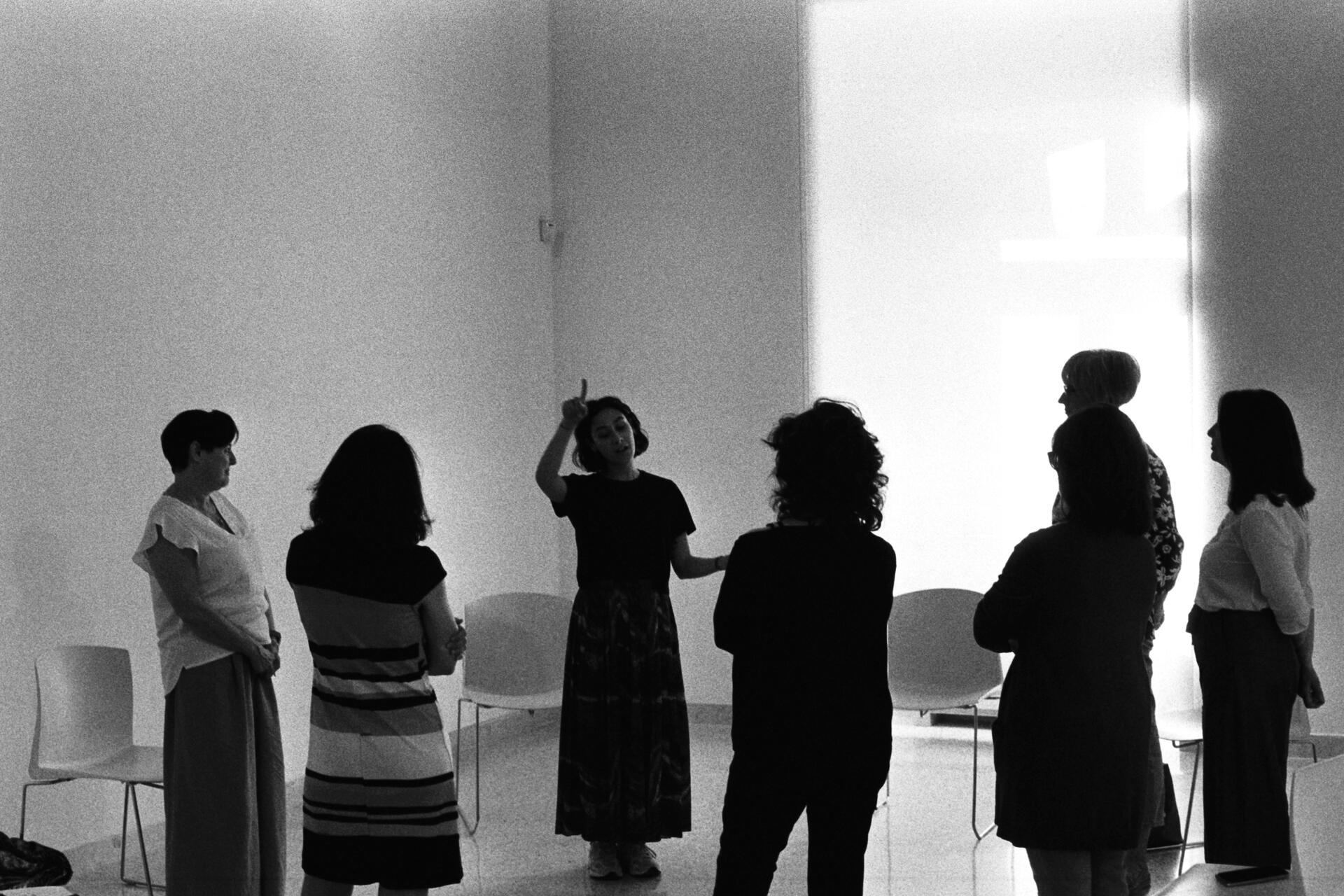
| Abstract | What happens when participants in an academic context are invited to speak in their mother tongues, even when no one else understands them? Departing from a critique of English hegemony in international conference settings, in this 90-minute laboratory participants are invited to resist the pressure of universal translatability and instead inhabit the particular sonic, rhythmic, and conceptual textures of their own native languages. The practice draws on a series of workshops in which specific grammatical features of participants’ languages (for example, the different ways languages express temporal relations) function as operative principles shaping a shared musical and conversational event. Grammar is not treated as a neutral container for meaning but as a generative force: a set of constraints and affordances that conditions how we think, listen, and relate to one another. The laboratory engages three productive tensions. First, between the desire to be understood and the musical qualities of speech (intonation, stress, rhythm) which remain communicative even when semantic content is opaque. Second, between the individual mother tongue as an irreducible epistemic resource and the collective space of a multilingual encounter. Third, between misunderstanding as failure and misunderstanding as opening — a site where new forms of meaning and new modes of listening can emerge. The laboratory emerges from my artistic research as a singer and improviser on the relationship between song and speech, and on how their interplay shapes processes of meaning-making in collective vocal practices. By privileging mother tongues over a shared lingua franca, the workshop enacts rather than merely discusses the conference’s concern with minoritised language and the interplay of power and language. |
| Image |
|
| Short biographies of the presenter(s) |
|
| Previous presentations or iterations of the research | This laboratory builds on over fifteen artistic experiments presented in artistic research contexts across Europe (SAR, EPARM, Forum Artistic Research). It operates as a serial methodology: a research device continuously reconfigured in response to context and emerging questions in my research. While the inquiry into song and speech remains central, each workshop functions as a site-specific experiment. The SAR 2026 version will extend this evolving investigation. |
| Additional information | The workshop alternates one-to-one encounters and collective reflection. It opens with a brief introduction to the conceptual and artistic framework, grounded in participants’ reflections on their mother tongues. A guided performance-conversation follows: in pairs, participants speak in their own languages in response to a shared prompt. As semantic access may be limited, attention shifts to prosodic and vocal features — rhythm, intonation, timbre — listening for meaning in the musicality of language. The session concludes with a discussion on language, music, and knowledge production in artistic research. Designed for 8–40 participants; no musical training required. Further background and documentation (including photos and videos) can be found here: https://www.researchcatalogue.net/shared/8204d27541759a8da33d58add308b558 |
| Spatial and technical requirements | A flexible room allowing participants to sit in a circle or semicircle, without fixed lecture-style seating. No additional technical requirements. |
| Potential risks or ethical concerns | Participants will be invited but never compelled to speak in their mother tongue. The session acknowledges that for some, the mother tongue may carry painful or ambivalent associations, and space will be held for those who prefer to listen. As a facilitator, I will make clear at the outset that participation is fully voluntary and that no linguistic performance will be evaluated. |
| Create a user account for SAR 2026 | Tá |
| Create new user | Miriana Faieta |