Secondary tabs
Submission information
Submission Number: 196
Submission ID: 251
Submission UUID: 0e347a07-01e6-4ec4-9110-2aae49948bc5
Submission URI: /ga/form/submit-contribution
Cruthaithe: Thu, 26 Feb 2026 - 21:51
Déanta: Fri, 27 Feb 2026 - 00:19
Changed: Wed, 13 May 2026 - 08:12
Remote IP address: 122.150.150.184
Submitted by: Anonymous
Teanga: English
Is draft: Níl
Current page: webform_confirmation
Personal Information
Your contribution
Fashioning Intelligence
English
While artificial intelligences (AI) are intensely deployed across industry and society to optimise production and expedite innovation, these technologies invoke curious fields of more-than-human (MTH) perceptions. As they replace human labour with machine automation, bodies with digital avatars, and relationships with synthetic communication, AIs position humans within relational ecologies of intelligences, creativity, and agencies rather than above. Countering anthropocentric assumptions, such shifts prompts explorations of nonanthropocentric MTH conceptual worlds.
Practice-led artistic research through fashion enable such explorations. As an interface through which humans render themselves, sensually engages surroundings, and affect interactions with another, fashion enables dressing into MTH experiences. By producing fashion artefacts in collaboration with AIs, including ChatGPT, CLO3D, and refiberd to generate creative concepts, expedite technical production, and optimise material use, challenges and opportunities are synthetically rendered and physically embodied. By investigating practicing fashion with AI, their compounded conditions of consumption, exploitation, and universalisation, as well as their conceptions of intelligence, creativity, and agency as distributed, may be meaningfully investigated.
For the conference, I propose a capsule fashion research installation. The collection presents 5 cohabitat artefacts, produced in collaboration with AI. It situates fashion as a field for exploring perceptions and developing embodied knowledge of endangered conceptual worlds. For instance, the Cohabitat Coat houses MTH by emulating the crevices of loggerhead turtle shells, as prompted by ChatGPT in response to habitats endangered by material pollution and disturbed by cabling. The collection materialises MTH resonance, positioning practice-led research as critical reconfiguration from within technological systems rather than as retreat from them.
Practice-led artistic research through fashion enable such explorations. As an interface through which humans render themselves, sensually engages surroundings, and affect interactions with another, fashion enables dressing into MTH experiences. By producing fashion artefacts in collaboration with AIs, including ChatGPT, CLO3D, and refiberd to generate creative concepts, expedite technical production, and optimise material use, challenges and opportunities are synthetically rendered and physically embodied. By investigating practicing fashion with AI, their compounded conditions of consumption, exploitation, and universalisation, as well as their conceptions of intelligence, creativity, and agency as distributed, may be meaningfully investigated.
For the conference, I propose a capsule fashion research installation. The collection presents 5 cohabitat artefacts, produced in collaboration with AI. It situates fashion as a field for exploring perceptions and developing embodied knowledge of endangered conceptual worlds. For instance, the Cohabitat Coat houses MTH by emulating the crevices of loggerhead turtle shells, as prompted by ChatGPT in response to habitats endangered by material pollution and disturbed by cabling. The collection materialises MTH resonance, positioning practice-led research as critical reconfiguration from within technological systems rather than as retreat from them.
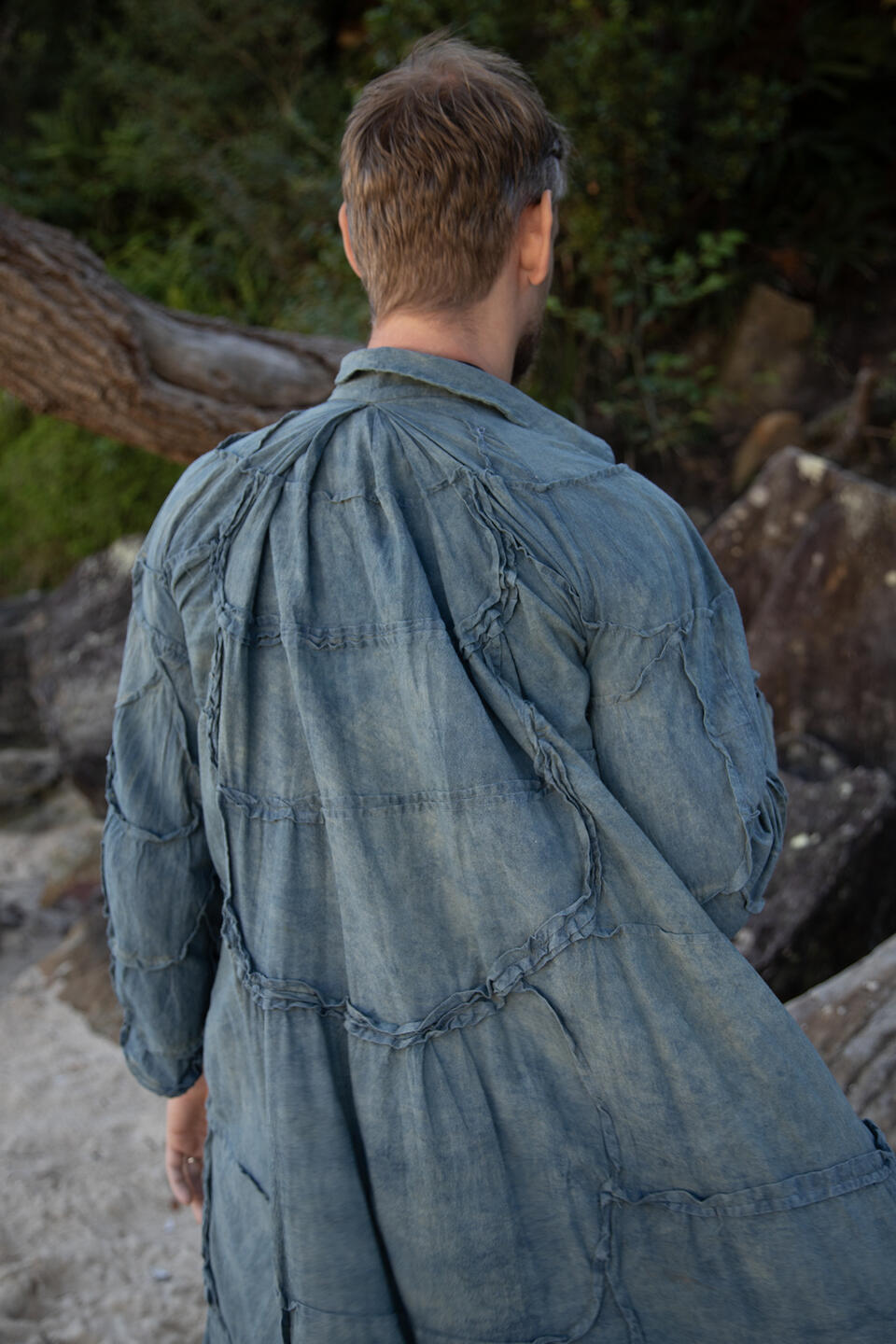
- Björn Eriksson is a Swedish critical fashion artist and researcher based in Sydney. His work explores fashion as a mediator between organisms, technology, and materials. Through speculative garments, installations, and writing, Björn investigates fashion as fostering care, memory, and ecological awareness. His projects often rework inherited or discarded textiles, creating artefacts prompting broad questions about value, labour, and responsibility. Björn is currently a PhD candidate at the University of Technology Sydney where his research examines artificial intelligence in fashion through more-than-human design. This work is situated within critical, practice-led, and speculative fashion design to reimagine the role of fashion in society.
Elements of this research have been presented in academic seminars and symposia in Australia, including at the Hacking Visual Culture conference and the Northern Beaches Environmental Art & Design Prize. The proposed installation represents a new configuration of the material, as well as investigative outfits exclusively produced for the SAR Conference, foregrounding endangered conceptual worlds.
Requirements
The installation will present five artefacts displayed suspended on hangers, overlaid with projected visualisations of AI interventions. The installation emphasises MTH material consequences and embodied encounters of AI in fashion processes. The artefacts function as research demonstrating practice-led artistic research in action. I will be present during designated sessions to discuss the research context and methodological framework.
Approx. 1 m² floor space per artefact. Adjustable lighting. Wall space for A4 poster with informational material. Power outlet for projector.
The research involves no human subjects or sensitive data. AI systems are used as design and production collaborators within artistic experimentation. All material processes follow institutional safety guidelines. No ethical risks anticipated.
Níl