Secondary tabs
Submission information
Submission Number: 143
Submission ID: 192
Submission UUID: 11bdd831-a2e1-42a1-9203-11930237bc4f
Submission URI: /ga/form/submit-contribution
Cruthaithe: Mon, 23 Feb 2026 - 17:29
Déanta: Mon, 23 Feb 2026 - 17:37
Changed: Wed, 13 May 2026 - 08:23
Remote IP address: 107.190.99.105
Submitted by: Cathy Paton
Teanga: English
Is draft: Níl
Current page: webform_confirmation
Flagged: Tá
Personal Information
Your contribution
Art-Shaped Analysis: Visual and Improvisational Practices as Sites of Inquiry
English
This project explores how qualitative analysis can be shaped through artistic practice, foregrounding visual and improvisational approaches as sites where knowledge is generated rather than represented. Emerging from a collaborative study with professional artists, the project investigates how artistic ways of knowing—often embodied, tacit, relational, and resistant to full verbalisation—can be sustained within research contexts without being flattened for clarity.
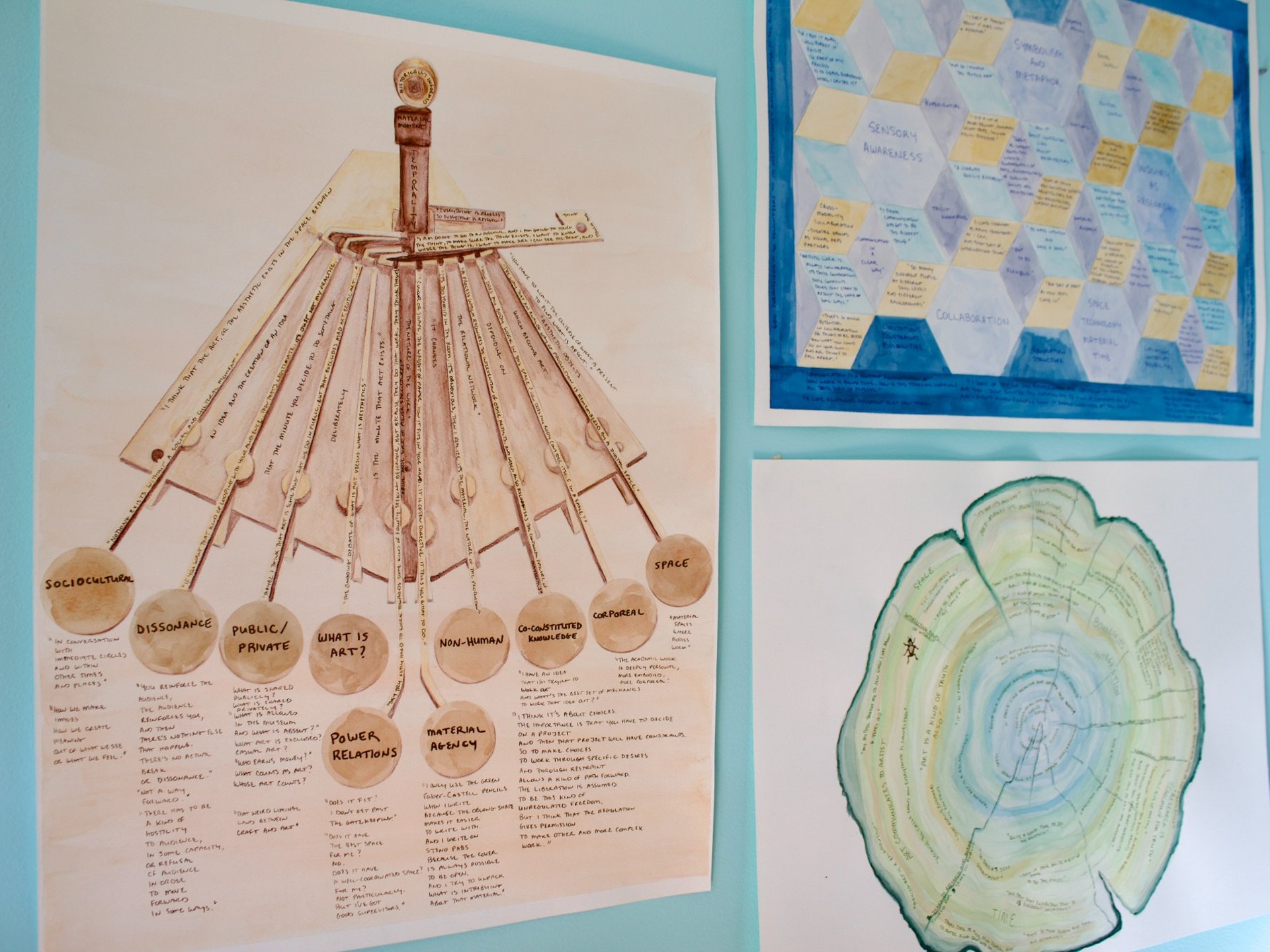
The inquiry unfolded through two intertwined analytic practices. One researcher engaged in improvisational listening and reflexive response, approaching analysis as an extension of the research encounter through attunement to tone, rhythm, affect, and relational shifts. In parallel, a visual artist-researcher developed image-based analytic works in response to the artists’ narratives. These visual works functioned not as illustrations of findings, but as analytic events—material processes through which relationships, tensions, and conceptual movements became perceptible.
Rather than extracting themes, the project remained in relation with uncertainty, allowing meaning to emerge through making, sensing, and collaborative attention. The resulting visual works hold endangered conceptual worlds—forms of knowledge that resist immediate legibility yet carry epistemic force through material, affective, and relational engagement.
The session will centre these visual analytic works, accompanied by improvisational exercises that draw participants into direct experience of attunement, relational attention, and in-the-moment responsiveness as epistemic orientations.
This project contributes to artistic research by demonstrating how art-shaped analysis can sustain complexity, protect minoritised ways of knowing, and resist extractive logics in qualitative research.
The inquiry unfolded through two intertwined analytic practices. One researcher engaged in improvisational listening and reflexive response, approaching analysis as an extension of the research encounter through attunement to tone, rhythm, affect, and relational shifts. In parallel, a visual artist-researcher developed image-based analytic works in response to the artists’ narratives. These visual works functioned not as illustrations of findings, but as analytic events—material processes through which relationships, tensions, and conceptual movements became perceptible.
Rather than extracting themes, the project remained in relation with uncertainty, allowing meaning to emerge through making, sensing, and collaborative attention. The resulting visual works hold endangered conceptual worlds—forms of knowledge that resist immediate legibility yet carry epistemic force through material, affective, and relational engagement.
The session will centre these visual analytic works, accompanied by improvisational exercises that draw participants into direct experience of attunement, relational attention, and in-the-moment responsiveness as epistemic orientations.
This project contributes to artistic research by demonstrating how art-shaped analysis can sustain complexity, protect minoritised ways of knowing, and resist extractive logics in qualitative research.
- Cathy Paton is an artist-researcher based in Hamilton, Canada. She holds a PhD in Social Work from McMaster University and remains affiliated with the School of Social Work. Her work explores artistic and relational approaches to qualitative inquiry, with particular attention to improvisation, embodiment, and collaboration. She has published open-access resources on art and research practice and has a manuscript on improvisation and interdependence currently in press. This project is developed in collaboration with Erin Kuri, a visual artist-researcher whose image-based analytic works are central to the research.
Portions of this research have informed ongoing manuscript development. The visual and improvisational analytic practices presented here have not previously been presented in this form at a conference. An image from this project was displayed at the Art of Research Competition at McMaster University (June 2025), a showcase of creative research methods. A graphic illustration developed from the research analysis has been shared informally outside of conference contexts.
Requirements
This laboratory session brings together physical art display, discussion of what research is and can be, and participatory improvisational experience. Three large-format watercolour analytic works will be displayed on the wall for close, in-person viewing — shared as primary research material rather than illustrations. The session will move through: an opening framing of the research and its analytic practices; time for participants to engage directly with the visual works; an improvisational exercise involving standing, gentle movement, and structured reflection to attune participants to in-the-moment responsiveness and relational attention; and open discussion. The exercise is invitational and requires no prior experience.
I will display three large-format watercolour works (approx. 1m × 70cm each) on the wall for close viewing; works will be mounted on backing boards. Wall space at eye level for three works is required; I will confirm mounting options with organizers closer to the date. The session includes an improvisational exercise involving standing and gentle movement; open floor space for participants is needed. Room size and participant numbers will inform the exercise design. No screens needed.
This session includes no sensitive personal data. Research participants consented to their participation in the study; the visual artist-researcher has consented to the display and discussion of her works. The improvisational exercise is low-risk, non-performative, with gentle and minimal physical movement; participants may opt out without explanation.
Tá
Cathy Paton