Secondary tabs
Submission information
Submission Number: 104
Submission ID: 147
Submission UUID: c84f4887-12f2-4182-99c9-13fac5e16cfa
Submission URI: /ga/form/submit-contribution
Cruthaithe: Wed, 18 Feb 2026 - 16:39
Déanta: Wed, 18 Feb 2026 - 16:48
Changed: Wed, 13 May 2026 - 08:14
Remote IP address: 79.47.100.247
Submitted by: Anonymous
Teanga: English
Is draft: Níl
Current page: webform_confirmation
| Given name | GIUSEPPE |
|---|---|
| Surname | RAMETTA |
| giusirames@hotmail.com | |
| I understand that by submitting this form, I consent to the use of my data for the purposes of the 2026 Forum on Artistic Research'. | Tá |
| I agree to the terms of service. | Tá |
| Title | VOICE IN TIME |
| Format | Project presentation |
| Main language | English |
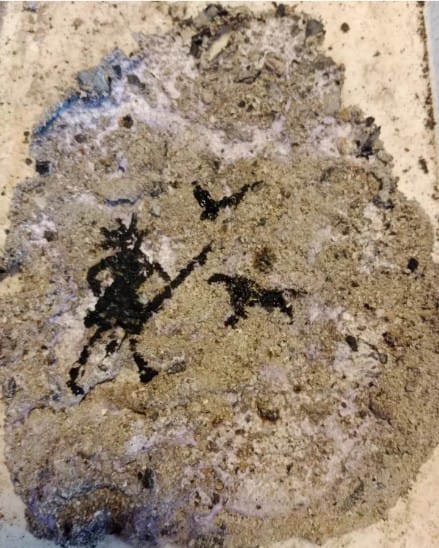
| Abstract | The Voice of Time — Short Summary The Voice of Time explores how vegetal matter can act as an active agent in the formation of contemporary rupestrian surfaces. Through processes of drying, pressing, inclusion and mineral stratification, leaves and organic membranes become archives of their own temporalities. Rather than representing nature, the work collaborates with its material behaviours—contraction, fracture, porosity, sedimentation—allowing time to manifest as a visible force. The project develops a replicable organo‑mineral protocol that transforms vegetal elements into “fossils of the present,” generating surfaces where the organic becomes geological and the ephemeral becomes material memory. Positioned within contemporary artistic ecologies, the research proposes the artwork as an ecosystem of relations between matter, process and temporality. |
| Link to the Exposition | https://www.researchcatalogue.net/view/4193863/4193862 |
| Image |
|
| Short biographies of the presenter(s) |
|
| Previous presentations or iterations of the research | |
| Additional information | Further information on the project presentation: "The proposed presentation focuses on the technical and aesthetic process of material synthesis, specifically the transition of liquid elements into solid artistic mediums. As an artist, I develop my own material mixes to achieve the solidification of oil and seawater, creating a unique 'solid sea' canvas. The accompanying Research Catalogue (RC) exposition is designed as a 15-minute visual and technical journey through these chemical-artistic transitions. It documents the stability and texture of the resulting surfaces, including the integration of metallic elements (such as stainless steel) within the solidified layers. During the presentation, I intend to discuss the methodology behind these original mixes and, if logistically feasible, provide physical samples for a tactile and visual assessment of the material’s evolution." |
| Spatial and technical requirements | Spatial and Technical Requirements: Space: A standard presentation room with a sturdy table or plinth to display physical samples of solidified oil and seawater. Lighting: Strong, direct lighting (preferably adjustable) to highlight the textures, transparency, and metallic reflections (stainless steel elements) within the material mixes. AV Equipment: * Digital projector and screen for the Research Catalogue exposition. HDMI connection for a laptop. Stable Wi-Fi |
| Potential risks or ethical concerns | Potential Risks or Ethical Concerns: Material Stability: The original material mixes used for the solidification of oil and seawater are chemically stable once cured. There are no risks of leakage or off-gassing during the presentation. Safety of Handling: The physical samples, including those incorporating stainless steel elements, are non-toxic and safe for tactile inspection by the audience. Environmental Impact: The research focuses on the "solidification of the sea" as a conc |
| Create a user account for SAR 2026 | Níl |