Secondary tabs
Submission information
Submission Number: 61
Submission ID: 99
Submission UUID: 63202c93-ff79-4242-8f59-dedeb95f7496
Submission URI: /ga/form/submit-contribution
Cruthaithe: Thu, 12 Feb 2026 - 13:10
Déanta: Fri, 13 Feb 2026 - 08:33
Changed: Wed, 13 May 2026 - 08:14
Remote IP address: 84.115.229.141
Submitted by: Anonymous
Teanga: English
Is draft: Níl
Current page: webform_confirmation
Personal Information
Your contribution
Walking Worlding Words with Forest
English
What made us forget to touch ground — even if the world still matters?
Take a handful of soil — humus containing more living beings than humans on the planet. With this minor gesture, Touch Ground stages a micropolitical shift in sensibility: affect becomes the capacity to affect and be affected within more-than-human entanglements.
Our encounter with ground, the world we inhabit, is mediated by settler-colonial abstraction regimes extended through platform urbanism, rendering land a measurable resource, navigable data surface, ownable asset, fragmenting heterogeneous worlds into commensurable units within extractive logics of equivalence.
Rather than representing an endangered world, the project reconfigures perception from within, making palpable the onto-epistemic rupture of the Digital Anthropocene: a dissociation between knowing about and being immanent to the world. Endangered is the lived sense of material entanglement from which tangible futures co-emerge.
This concerns children under postdigital subjectivation within data-capitalist infrastructures operationalizing perception and enforcing self-optimization, eroding shared experiential worlds, pre-formatting imagination, foreclosing becoming otherwise.
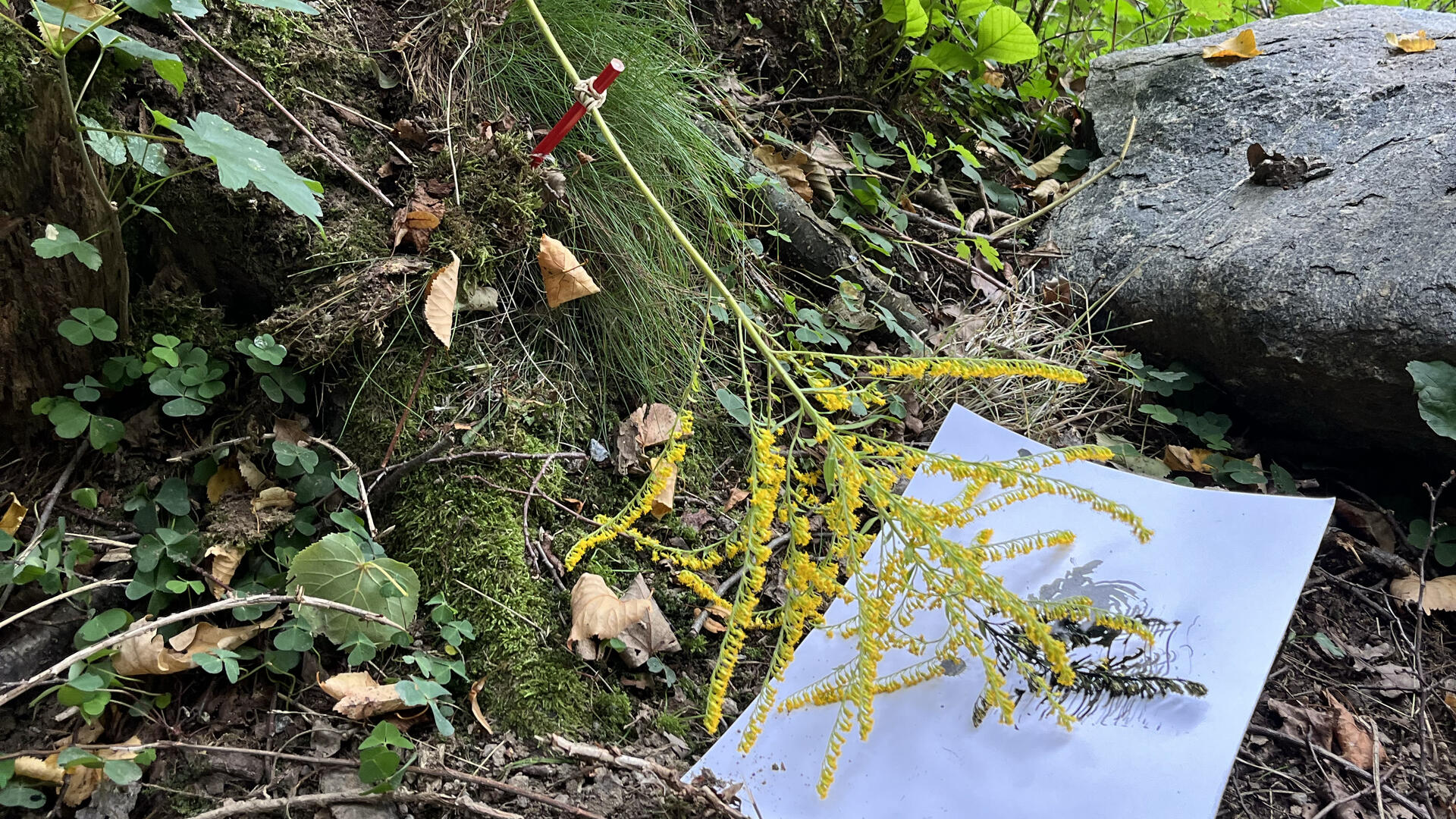
In Walking Worlding Words with Forest, children enter the forest as speculative ecology, a thick present of becoming-with. Through walking-with, they approach found fragments as a sensing objectory, assembling answering apparatuses from reused architectural tools, affecting-with wind and weather. A contact zone unfolds that invites correspondence and resonance.
Rather than defining resonance conceptually, artistic research thickens theory by forcing it to take place. As resistance, it refuses optimization and control, sustaining shared situations in which other modes of worlding can be rehearsed. The presentation combines performative documentation and weather-altered drawings, holding open the ineffable, where sensing precedes articulation.
Take a handful of soil — humus containing more living beings than humans on the planet. With this minor gesture, Touch Ground stages a micropolitical shift in sensibility: affect becomes the capacity to affect and be affected within more-than-human entanglements.
Our encounter with ground, the world we inhabit, is mediated by settler-colonial abstraction regimes extended through platform urbanism, rendering land a measurable resource, navigable data surface, ownable asset, fragmenting heterogeneous worlds into commensurable units within extractive logics of equivalence.
Rather than representing an endangered world, the project reconfigures perception from within, making palpable the onto-epistemic rupture of the Digital Anthropocene: a dissociation between knowing about and being immanent to the world. Endangered is the lived sense of material entanglement from which tangible futures co-emerge.
This concerns children under postdigital subjectivation within data-capitalist infrastructures operationalizing perception and enforcing self-optimization, eroding shared experiential worlds, pre-formatting imagination, foreclosing becoming otherwise.
In Walking Worlding Words with Forest, children enter the forest as speculative ecology, a thick present of becoming-with. Through walking-with, they approach found fragments as a sensing objectory, assembling answering apparatuses from reused architectural tools, affecting-with wind and weather. A contact zone unfolds that invites correspondence and resonance.
Rather than defining resonance conceptually, artistic research thickens theory by forcing it to take place. As resistance, it refuses optimization and control, sustaining shared situations in which other modes of worlding can be rehearsed. The presentation combines performative documentation and weather-altered drawings, holding open the ineffable, where sensing precedes articulation.
- Theresa Schütz lives and works in Vienna. Through situated, performative, and embodied inquiry into public and social space, her material-discursive critical spatial practices explore what can be shared and sensorially experienced in relational in-betweens. She co-founded urban initiatives and curates T/abor as a transdisciplinary art lab in Vienna. As a doctoral researcher in the STEAM programme at TU Wien, she investigates artistic research practices that unfold transversal learnscapes with children and youth for futuring otherwise and environ/mental emancipation.
16th International Conference on Artistic Research, ‘16th International Conference on Artistic Research, University of Porto‘, Research Catalogue(2025) https://www.researchcatalogue.net/view/2759372/3582572/0/0 [accessed 12/02/2026]
I was part of the 16th SAR Poster Session and presented "Unfolding Transversal Learnscapes for Environ/mental Emancipation" to conceptualize the following artistic research practices with children walking-with the forest.
I was part of the 16th SAR Poster Session and presented "Unfolding Transversal Learnscapes for Environ/mental Emancipation" to conceptualize the following artistic research practices with children walking-with the forest.
Requirements
The presentation begins with a brief performative opening: the guiding question is placed within a small amount of soil at the center of the space, inviting participants to take a note and, if they wish, hold a fragment of earth. A short moment of silent walking introduces the inquiry as a spatial proposition before transitioning into a 20-minute lecture supported by photographic documentation from forest-based workshops with children. The session includes moderated reflection and discussion.
I will bring my own laptop and require a projector with HDMI connection. A circular seating arrangement and a small open space in the center are preferred. A table or surface to place material objects (soil, drawings) would be helpful. No additional technical setup is required.
The presentation includes a small performative gesture using soil. Participation is voluntary. The soil will be collected and reused; it will not be discarded. Workshop documentation involves children; no identifiable images, audio, or video recordings will be shown. Consent procedures were followed and participants’ privacy will be protected.
Tá
Theresa Schütz