Secondary tabs
Submission information
Submission Number: 366
Submission ID: 433
Submission UUID: f03daa77-7ec8-494c-8006-0ee161c69b19
Submission URI: /ga/form/submit-contribution
Cruthaithe: Mon, 2 Mar 2026 - 10:59
Déanta: Mon, 2 Mar 2026 - 17:35
Changed: Wed, 13 May 2026 - 08:12
Remote IP address: 62.43.107.121
Submitted by: Anonymous
Teanga: English
Is draft: Níl
Current page: webform_confirmation
Personal Information
Your contribution
Rewriting Images: Performance as epistemic intervention in colonial visual archives
English
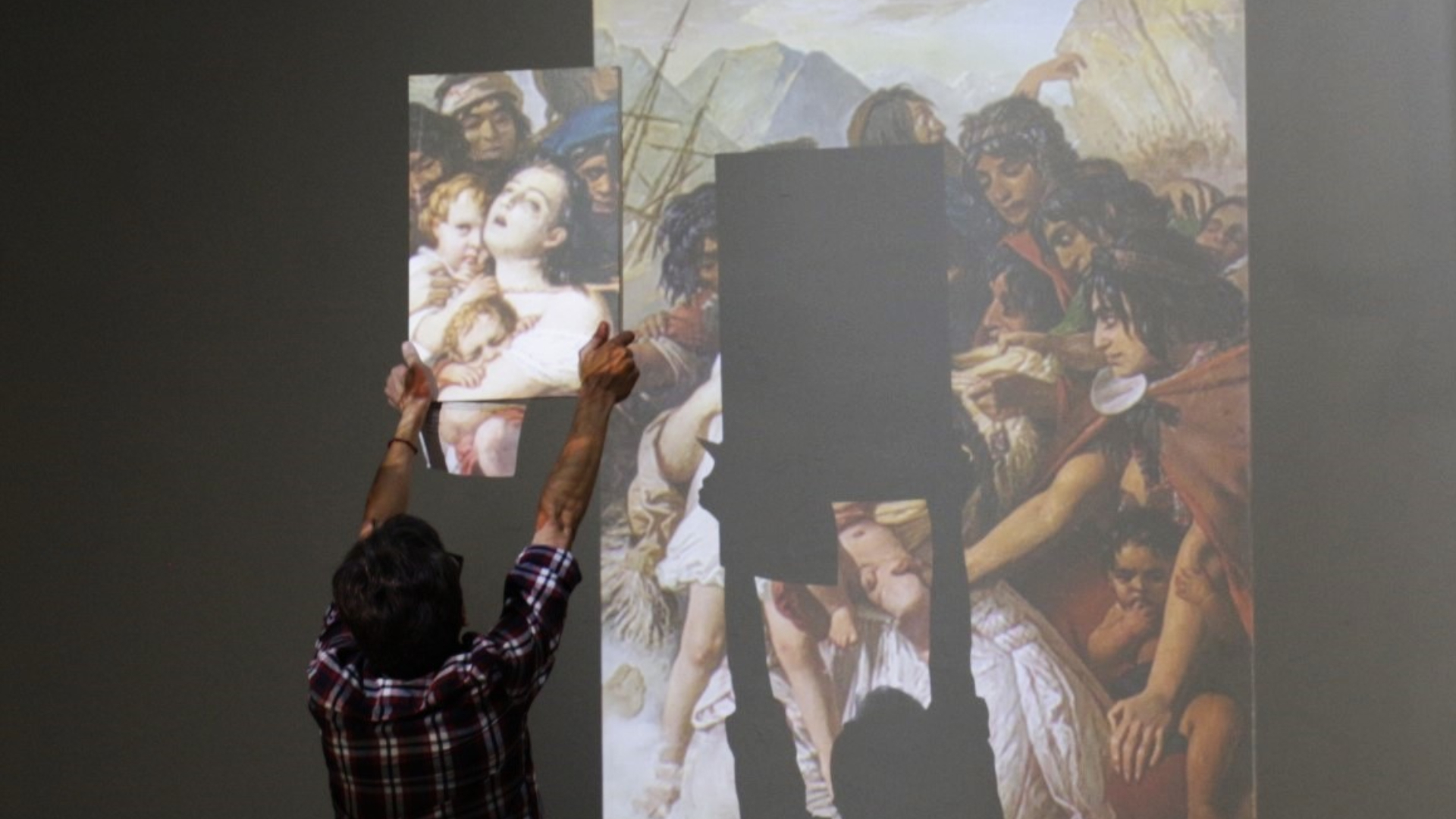
This artistic research project investigates how performative rewriting can operate as an epistemic intervention within colonial visual archives. It takes as its point of departure the 1859 painting El naufragio del Bergatin joven Daniel by Raymond Monvoisin, a work that stages the encounter between a white female survivor of a shipwreck and indigenous inhabitants in southern Chile. Rather than approaching the painting as a historical object to be interpreted, the project treats it as an active visual structure that continues to organize perception, affect, and subject positions in the present.
Through a documented artistic laboratory, the image is activated using methods of slow collective observation, dialogical unfolding, spatial reconfiguration, and performative re – enactment. The body becomes an analytical instrument. By redistributing positions, gestures, and proximities within the original composition, the performance displaces the colonial narrative embedded in the painting and exposes its regime of visibility.
The resulting performative act does not illustrate critique but produces knowledge through embodied experimentation. Rewriting emerges here as a research operation a way of interrogating how images distribute vulnerability, silence certain bodies, and naturalize hierarchies. The project argues that artistic practice can function as a mode of visual thinking capable of revealing and interrupting inherited structures of seeing.
By articulating performance as a method of archival inquiry, this research contributes to the field of artistic research through an embodied, relational, and process-based epistemology. It proposes that intervening in images is not only an aesthetic gesture but also a way of transforming how knowledge about history, representation, and alterity is produced.
Monvoisin, R. (1859). El naufragio del Bergantín joven Daniel. Museo O´higginiano y de Bellas Artes, Talca, Chile. https://www.surdoc.cl/registro/7-180
Through a documented artistic laboratory, the image is activated using methods of slow collective observation, dialogical unfolding, spatial reconfiguration, and performative re – enactment. The body becomes an analytical instrument. By redistributing positions, gestures, and proximities within the original composition, the performance displaces the colonial narrative embedded in the painting and exposes its regime of visibility.
The resulting performative act does not illustrate critique but produces knowledge through embodied experimentation. Rewriting emerges here as a research operation a way of interrogating how images distribute vulnerability, silence certain bodies, and naturalize hierarchies. The project argues that artistic practice can function as a mode of visual thinking capable of revealing and interrupting inherited structures of seeing.
By articulating performance as a method of archival inquiry, this research contributes to the field of artistic research through an embodied, relational, and process-based epistemology. It proposes that intervening in images is not only an aesthetic gesture but also a way of transforming how knowledge about history, representation, and alterity is produced.
Monvoisin, R. (1859). El naufragio del Bergantín joven Daniel. Museo O´higginiano y de Bellas Artes, Talca, Chile. https://www.surdoc.cl/registro/7-180
- José Rolando is an artist-researcher whose work investigates how visual archives and colonial imaginaries shape contemporary regimes of visibility. His practice integrates documentary, performative rewriting, and collaborative artistic laboratories as methods of embodied knowledge production. He approaches images as active structures that organize perception and sustain conceptual worlds rooted in historical asymmetries. He holds a Master’s degree in Research in Artistic and Visual Practices from the University of Castilla-La Mancha and is a member of the Alfamed Joven research group, where he develops research connecting artistic methodologies with critical media literacy and situated epistemologies.
- PhD. Cecilia Gomez V. Journalist graduated from Universidad Católica del Norte (Chile) and holder of an MA in Documentary Film from Universidad de Chile. She also earned an MA in Educational Research and Innovation and a PhD in Research in Humanities, Arts and Education from Universidad de Castilla-La Mancha (Spain). She is a researcher and educator in media education and media literacy, combining university teaching with the design of training programmes for children, youth, and adults. Her work promotes digital competencies, critical engagement with media discourses, and digital citizenship from a gender-sensitive and representational analysis perspective. She is currently a researcher in Red Alfamed.
An early stage of this project was presented in 2023 at the research meeting "Escarbar a oscuras" at the University of Castilla-La Mancha, Spain. It later developed into an audiovisual creation laboratory at the University of Antofagasta, Chile, where a collective audiovisual piece was produced, now forming a central component of the current SAR proposal.
Requirements
{Empty}
This project requires essential technical equipment to ensure proper presentation. A high-resolution digital projector is necessary to display images clearly and at an appropriate scale. A sound system with quality loudspeakers is also required to guarantee clear voice projection and balanced audio. The space should include a suitable projection surface, electrical access, and adequate acoustics for optimal visibility and sound clarity.
{Empty}
Tá
Jose Rolando Jorquera