Secondary tabs
Submission information
Submission Number: 244
Submission ID: 304
Submission UUID: 845a75e3-95a4-4fad-b22e-1997e569ddf5
Submission URI: /ga/form/submit-contribution
Cruthaithe: Sat, 28 Feb 2026 - 16:42
Déanta: Sat, 28 Feb 2026 - 23:07
Changed: Wed, 13 May 2026 - 08:31
Remote IP address: 69.114.164.215
Submitted by: Anonymous
Teanga: English
Is draft: Níl
Current page: webform_confirmation
Flagged: Tá
Personal Information
Your contribution
What Do You Want With the Archive About You?
English
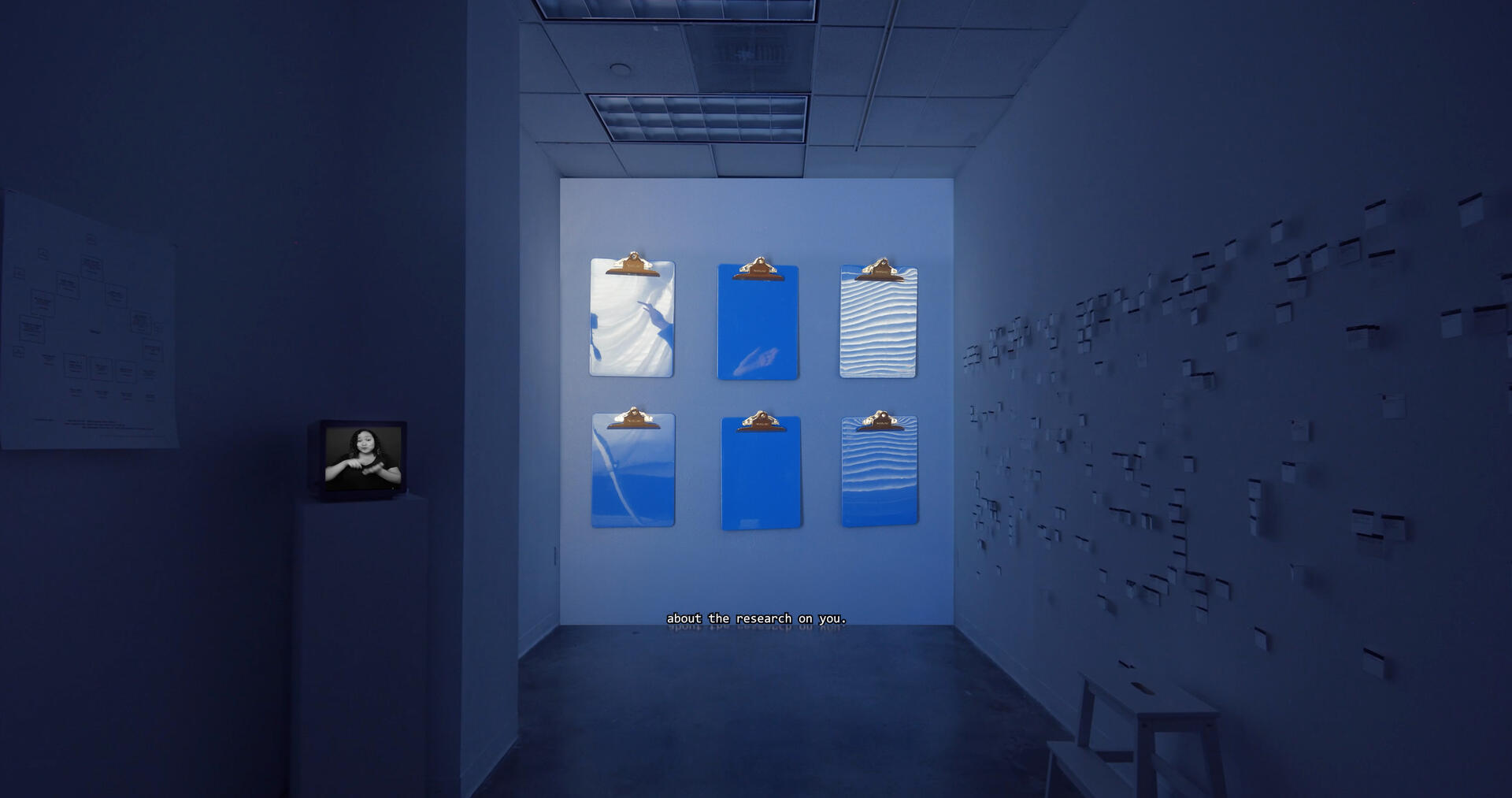
This video, accompanied by a media archeology paper, audits the sealed archive of one of the most influential type specimens of American science history and famous “feral” children in popular culture, marking the slip of this word to cover not wild and unsocialized but imprisoned and deprived. Susan Wiley was disappeared and confined in isolation for 13 years by her abusive parents. For the next 5 years she was intensively scrutinized as a scientific research subject. Taken as a control variable of human isolation, she -as represented through her scientific case- is massively influential in the fields of child development, psychology, linguistics, neuroscience, and -I argue- the architectures of unsupervised deep machine learning in artificial intelligence today.
I join a legacy of critical inquiry regarding the ethics of her treatment as a “forbidden experiment” pseudonymed “Genie” to emerge and grant the wishes of researchers.Namely, she is instantiated as the scientific subject used to test the now defunct Lenneberg "critical period" hypothesis: that (what counts as) language must be acquired by puberty or it will not be acquired at all. Her case still widely taught, with the general conclusion that neglect made her incapable of learning to express herself. This is false. And, in the search to fit her to this experiment, so much is lost about her own ways of knowing and communicating in the world.*
In affiliatively refocusing on her actions of expression that have slipped the archive’s seal and official scientific narrative, I find cause to challenge the assumptions that rest on her. Visual, somatic, and spatial modelling reveal ways to repatriate this sealed archive of primary source documents about, of, and by her to her: culturally, historically, internationally, poetically, politically, musically, speculatively, and actually. Now, with an idea of what is there and possible, I want to ask Susan what she wants.
*Including ASL. Interpretation by Joyce Hom.
I join a legacy of critical inquiry regarding the ethics of her treatment as a “forbidden experiment” pseudonymed “Genie” to emerge and grant the wishes of researchers.Namely, she is instantiated as the scientific subject used to test the now defunct Lenneberg "critical period" hypothesis: that (what counts as) language must be acquired by puberty or it will not be acquired at all. Her case still widely taught, with the general conclusion that neglect made her incapable of learning to express herself. This is false. And, in the search to fit her to this experiment, so much is lost about her own ways of knowing and communicating in the world.*
In affiliatively refocusing on her actions of expression that have slipped the archive’s seal and official scientific narrative, I find cause to challenge the assumptions that rest on her. Visual, somatic, and spatial modelling reveal ways to repatriate this sealed archive of primary source documents about, of, and by her to her: culturally, historically, internationally, poetically, politically, musically, speculatively, and actually. Now, with an idea of what is there and possible, I want to ask Susan what she wants.
*Including ASL. Interpretation by Joyce Hom.
- Carrie Marie Schneider is a research-based media installation artist with an extensive background in socially engaged frameworks. Her projects on archives, creativity, labor organizing, memorials, and climate change have been featured at the Contemporary Arts Museum Houston, Menil Collection, Transart Foundation for Art and Anthropology, Leonardo Art & Science Rendevous, EFA Project Space, Westbeth Gallery, Bemis, Tufts University, The Design Studio for Social Intervention, Somatische Akademie Berlin, and the US Department of Art and Culture. She was an inaugural Research Fellow with Project Row Houses and the University of Houston’s Center for Art and Social Engagement. She holds a BFA from MICA (2009) and MFA from Rutgers (2023).
-Became second unofficial MFA Thesis upon graduation, as I got pulled into Feminist STS
-Developed while auditing Visualization Design course with Atif Akin after graduating
-Prototype installation and feedback at Rutgers University while in development
-Paper was used as background guide for collaborators, then turned into Writing Sample as finalist application for UCSD's PhD in Practice program
-Used as direction for original score composed by Flannery Cunningham for a song gift for Susan
-Developed while auditing Visualization Design course with Atif Akin after graduating
-Prototype installation and feedback at Rutgers University while in development
-Paper was used as background guide for collaborators, then turned into Writing Sample as finalist application for UCSD's PhD in Practice program
-Used as direction for original score composed by Flannery Cunningham for a song gift for Susan
Requirements
Additional materials: https://tinyurl.com/ax8s6jas
I've tapped input from multidisciplinary practitioners in the East & West Coast, USA, but
1. I would love international POV on this work
2. a major component of recovered archive material is abroad
3. expanded research is essential to not reperform violence
Alignment with conference themes:
Making seeable - audit of indefinitely sealed archive using art practice visualization, spatialization, and installation
Making sayable - forefronting that Susan did acquire language- American Sign Language, but also forms of expression such as drawing, invention, performance, and modes unnameable to our disciplines
Exploring the ineffable - countering the inherited knowledge that abuse can steal the ability to express, using visual means where viewing is disallowed, avowing the sonic environment in visual deprivation, my theory of creativity grounded in Elaine Scarry’s 1984 The Body in Pain: The Making and Unmaking of the World
I've tapped input from multidisciplinary practitioners in the East & West Coast, USA, but
1. I would love international POV on this work
2. a major component of recovered archive material is abroad
3. expanded research is essential to not reperform violence
Alignment with conference themes:
Making seeable - audit of indefinitely sealed archive using art practice visualization, spatialization, and installation
Making sayable - forefronting that Susan did acquire language- American Sign Language, but also forms of expression such as drawing, invention, performance, and modes unnameable to our disciplines
Exploring the ineffable - countering the inherited knowledge that abuse can steal the ability to express, using visual means where viewing is disallowed, avowing the sonic environment in visual deprivation, my theory of creativity grounded in Elaine Scarry’s 1984 The Body in Pain: The Making and Unmaking of the World
Ideally the projection should be 3x2.5m on a white or light-neutral wall without bright/direct light around it. I can bring a short throw projector, but need a table stand for it, and electricity.
The video loop is 11 min long. I provide 3 headphones so people can access spoken English language, ambient sounds such as what Susan may have heard from her room even while she was considered deprived of language (birds, trains, wind), and headphones for reducing the ambient sound in the space.
The video loop is 11 min long. I provide 3 headphones so people can access spoken English language, ambient sounds such as what Susan may have heard from her room even while she was considered deprived of language (birds, trains, wind), and headphones for reducing the ambient sound in the space.
The timing of the conference is in tight sequence with my trip to Los Angeles in May to contact Susan to find out her wishes, but the ethical risks remain the same: that anyone might use the data I’ve attained for further click bait, toxic news cycles, or exploitative study that would re-entrench the limited story about her without her representation. However, the potential to find SAR interlocutors of integrity who can equip a nonexploitative, critical, expansive approach is my hopeful bet.
Tá
Carrie Marie Schneider